



GitHub Universe 2026 Recap
Industry

Machines on-call for humans


Written by
 Spiros XanthosFounder and CEO
 Mayank AgarwalFounder and CTO
Production is no longer manageable by humans alone; in the last week, Microsoft 365 was down for nearly a day. The FAA halted every US departure for almost five hours. Thousands of JPMorgan Chase customers couldn't get into their accounts. The NSA's classified network went offline. More than one followed a routine change, and the pattern is getting more common. AI writes code faster than teams can review it, security patches arrive faster than teams can roll them out, and all of it lands in production.
Keeping up with this volume and velocity of change means moving AI from an assistant to the critical path and humans out of the loop. But in production, mistakes are costly and every minute of delay adds damage, so the AI has to be on the frontier in quality and latency. It also runs on every symptom, change, and alert, so it has to be very cost-effective token-wise.
Today we are announcing two breakthroughs, starting with SRE-1, our first model, a 27B dense model, post-trained with reinforcement learning on open weights. SRE-1 dominates the Pareto frontier of accuracy against cost on root cause analysis of production issues, beating frontier models.
On top of SRE-1, our research on inference-time compute, evals, and learning also lets Resolve's agents deliver 2x the accuracy of coding agents on frontier models at 2x the speed. This enables our second breakthrough: putting Resolve on the critical path with cost-effective, closed-loop remediation, starting with on-call. Resolve holds the pager: it receives every alert, investigates it, and resolves or escalates it before an engineer is woken.
An agent that hands an RCA to a human is useful but doesn't reduce the cognitive load, since an engineer still has to wake up, verify the RCA, and decide the action. Delegating all of the work to agents means putting them on the critical path, and that takes consistently beating the best general-purpose models on accuracy, latency, and cost at the same time.
The agent also needs a complete platform around it. The platform has to understand production in real time and carry every security and action control. It also has to connect to every available tool. And it needs a single shared brain across every agent that learns reflectively from each investigation.
Building that takes a research lab and deep production expertise. The lab brings the rigor around the model, harness, and evals. The domain expertise defines what a correct answer looks like. It shapes the environments, the answer keys, and the closed-loop actions that verify recovery before the work is closed.
Without both, the best you can do is call the most capable model available. That does not scale on cost, and when it fails, you have no way to tell why or to fix it.
We evaluated SRE-1 on complex production cases, each run five times and scored against a verified root cause, measuring accuracy per dollar. A single SRE-1 investigation matches the frontier model we tested, at medium effort, for about a fifth of the cost, and an ensemble of five investigations synthesized tie that model at its highest effort for 37% less. SRE-1 also keeps converting additional inference compute into accuracy, while the general-purpose models we evaluated flatten out past a point.
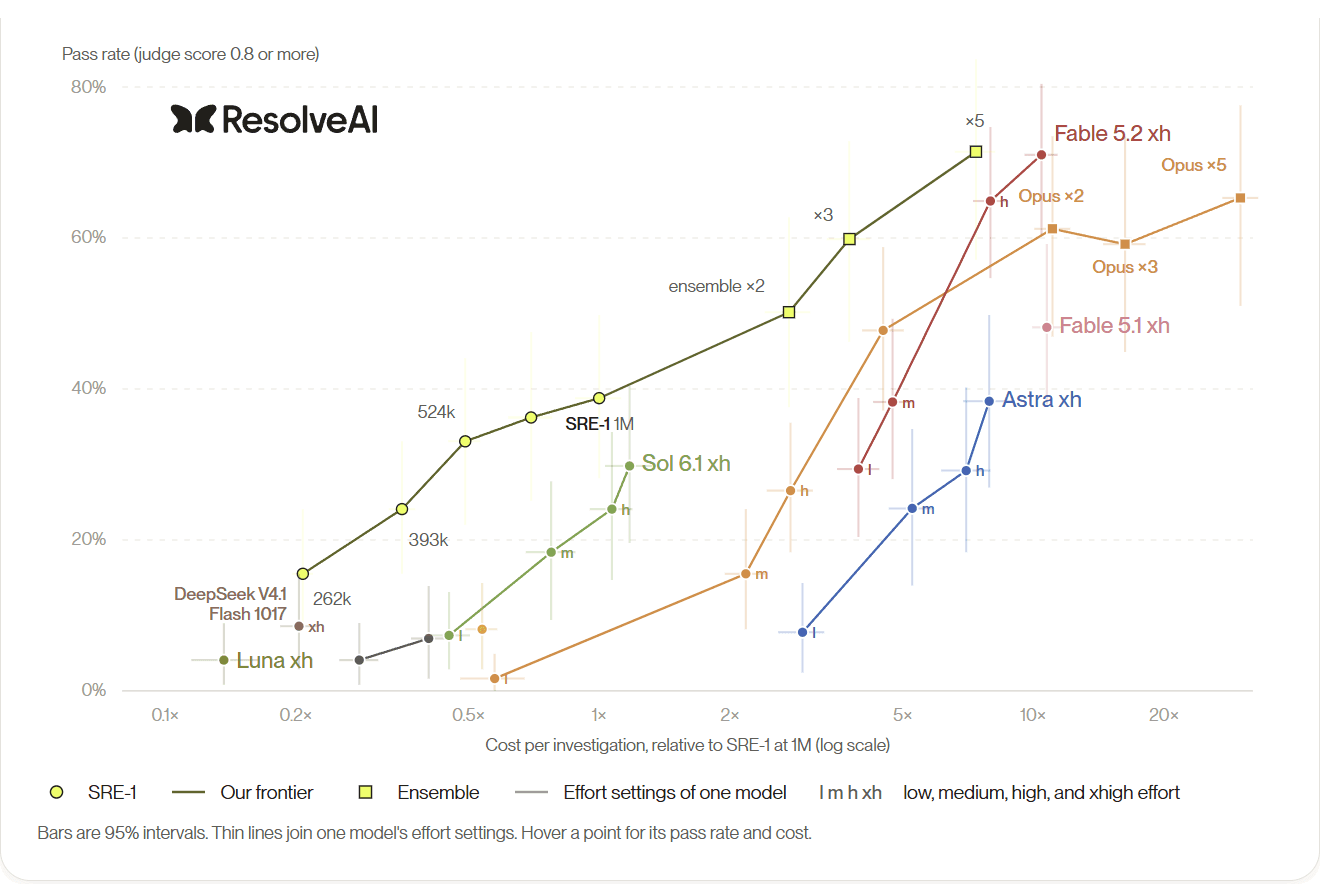
Figure 1: SRE-1's configurations dominate the frontier of pass rate against cost, on complex production cases run five times each. We traverse the frontier by varying context budget and ensembling strategy. Full method and per-configuration numbers are in the SRE-1 technical report.
"AI in production has to deliver more than promising results in a demo. It needs to be accurate, dependable, and economically viable at scale. Domain-specific models like ResolveAI's SRE-1 represent an important step toward making AI a meaningful part of how we detect, investigate, and resolve incidents. At Zscaler, where we protect the world's largest enterprises, including more than 50% of the Fortune 500, we see significant opportunity to work with ResolveAI to improve reliability for our customers."
— Misha Kuperman, Chief Reliability Officer & GM, Zscaler
Breakthroughs and techniques got SRE-1 to that accuracy at that cost.
We built SRE-1 with Snowflake as the first design partner of their Cortex training platform.
"ResolveAI's SRE-1 model shows what a domain-specific model can deliver for production. The fact that ResolveAI has managed to produce this model is a testament to the team's deep modeling and RL talent. We are proud to have supported ResolveAI as the first design partner for Snowflake Cortex Training, which they used to build SRE-1"
— Vivek Raghunathan, SVP of Engineering at Snowflake
Alongside the SRE-1 benchmark, we tested the complete agentic system against coding agents, because a model score is only part of the answer: the harness that holds an investigation together, the investigations that run in parallel, the production context each one reaches, and the tools it can call all shape the end results engineering teams get during high-pressure situations. Across production incident investigations, run on the same alerts, sandbox, and data as the evaluated coding-agent harnesses, Resolve solved about twice as many incidents as the coding-agent harnesses we evaluated and reached root cause faster. On the hardest third of alerts, its root-cause score was 15 to 25% higher.
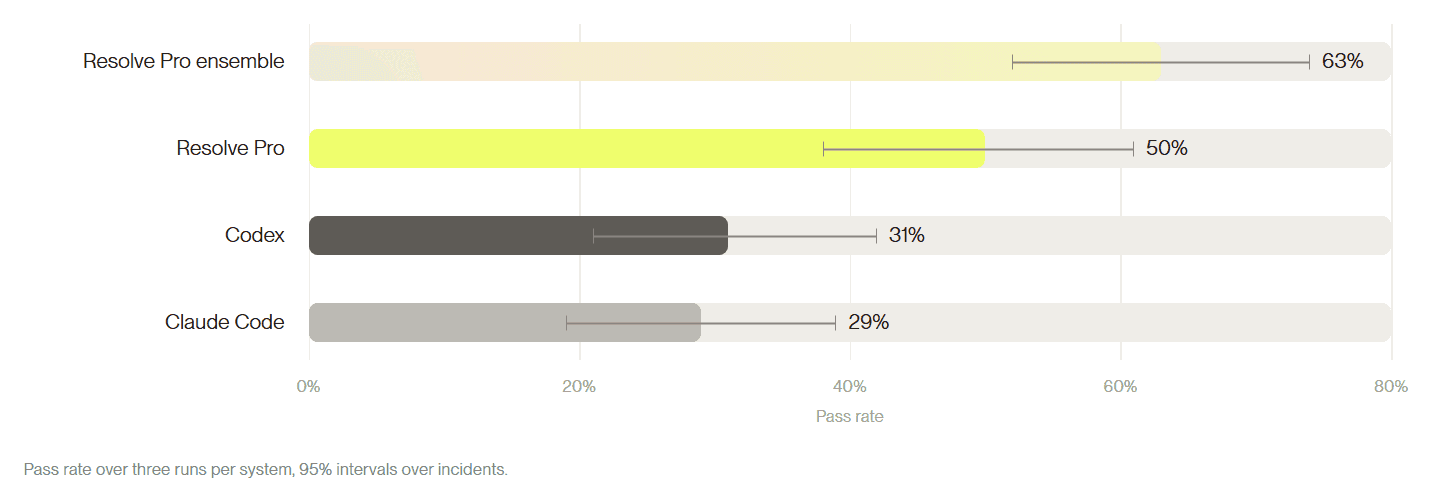
Figure 2: Platform benchmark. Pass rate over three runs per system, with 95% intervals over incidents. Additional details available here.
The only way to keep up with AI-generated code, vulnerability patching, and general environment churn is with very high-accuracy, token-efficient, trusted agents on the critical path.
With Primary On-call, Resolve goes on the critical path. It receives the page first and quickly decides whether to escalate. It investigates the issue within the existing escalation window, using telemetry, infrastructure, code, deployments, and accumulated knowledge about the service. It closes noise with an explanation; where your policies permit, it makes the fix and verifies the recovery before closing the issue. When a person is needed, Resolve escalates with the evidence, its current assessment, and a proposed next step.
Primary On-call also goes after what keeps generating those pages. Resolve ties every alert and every investigation that traces back to the same cause to one issue, so the alert that fires every Tuesday and gets acknowledged every Tuesday stops being thirty separate pages and becomes one piece of work. Within your approved scope, Resolve carries that context into remediation, including work delegated to coding agents, and confirms the alerts that issue was producing have stopped. The next rotation inherits fewer things that can fire at all.
Teams running Resolve in production see mean time to resolution improve by 10x or more, with up to 95% root-cause accuracy on investigations, and those running Primary On-call close up to 80% of pages without waking anyone.
Salesforce is putting Primary On-call in its paging path as the first responder.
"ResolveAI has been part of how our CRM Analytics team handles incidents, so extending it to ResolveAI Primary On-call was the natural next step. In the first few weeks of our dark launch testing, ResolveAI has closed more than 70% of our paging alerts without waking an engineer, with high accuracy. That's why we're ready to put ResolveAI Primary On-call in our paging path as our first responder."
— Bhupesh Patel, Software Engineering Principal Architect:
"ResolveAI helps us get to answers faster, share context across on-call rotations, and tackle recurring problems so our engineers have more time to build."
— Al Kemner, Head of Reliability & Forward Deployed Engineering at Figma
We will train more models to meet more of production's demands, and we will build trusted agents that run every production task within policy, so production runs itself, safely and reliably.
Primary On-call is generally available today. As part of this launch, we are offering the first three months of Primary On-call free, so you can put Resolve to work on your own production. Get started today and put machines on-call for humans.
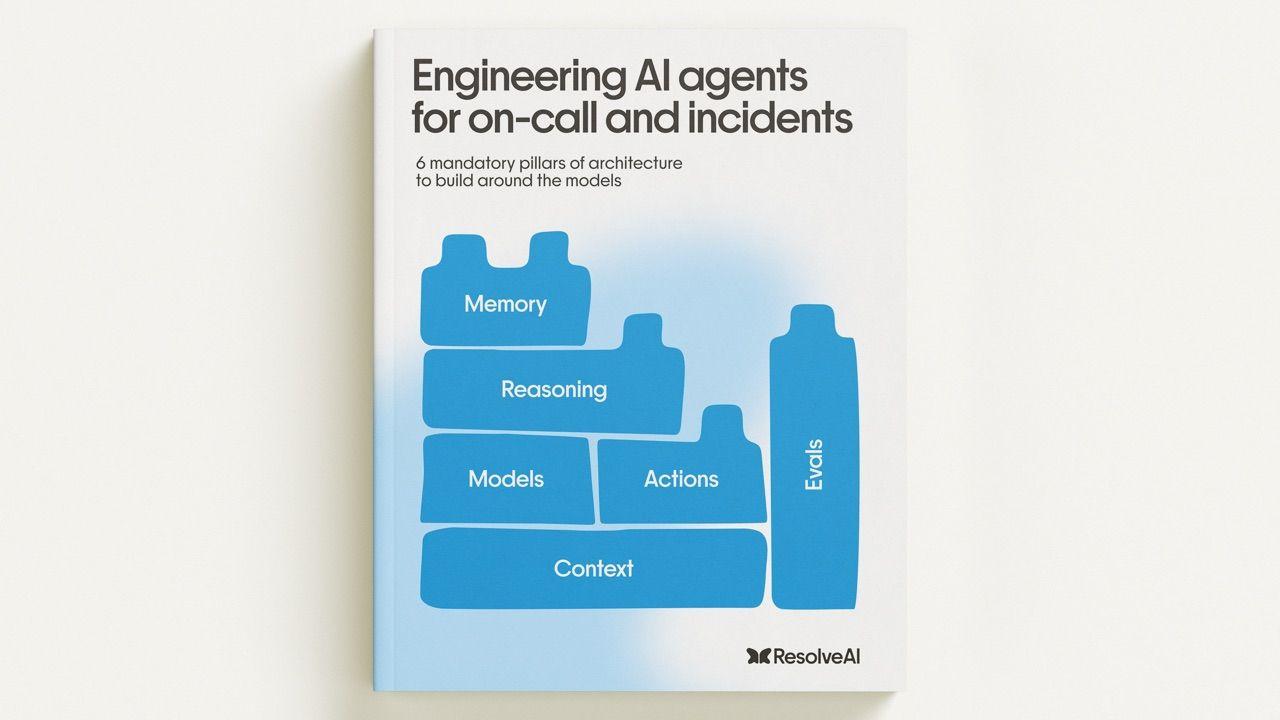
AI for prod ebook
Learn how top engineering teams use AI to run production.
See the agents that run and fix software in action
Join our engineering leads for "Behind the Build", a webinar series deep-dive into how we built agents that run software.