Loading the page…

Machines on-call for humans
Machines on-call for humans

Your guide to a few key terms in Agentic AI and software engineering.
Explore our comprehensive Agentic AI fundamentals: key concepts and terms, architecture components, operational frameworks, and best-practice implementation and scaling strategies for autonomous AI agents

A technical guide to debugging Pod Pending states. Explore the impact of zone-locked PVs, PriorityClasses, and the latency differences between Cluster Autoscaler and Karpenter.
Not all AI debugging tools work the same way. In this article we compare three architectural approaches to AI-assisted debugging: their tradeoffs, limitations, and where each works best in production environments.
Learn how AI-powered detection identifies production issues in real-time, where it adds value, where it falls short, and what determines trustworthy AI tools.
Modern production systems have outgrown human cognitive capacity. Learn how AI-powered reliability systems detect issues in real-time, investigate root causes across domains, and help engineering teams ship faster with confidence.
A phase-by-phase look at where AI helps across the software development lifecycle, from code generation to production operations, and where the gaps are.
Learn how PostgreSQL deadlocks form, how to read deadlock log output, and how to fix the four most common patterns including row-level lock inversion, multi-table escalation, and SELECT FOR UPDATE conflicts.
Kubernetes 502 errors mean your ingress controller reached a backend pod and got something unusable back. This guide covers the most common causes like misconfigured readiness probes, service selector mismatches, wrong target ports, and backend timeouts with the exact commands to diagnose and fix each one.
A 503 in Kubernetes means zero healthy backends in the endpoint pool. This guide covers the most common causes — empty endpoints, failing readiness probes, selector mismatches — and how to trace each one.
Alert investigation is the process of determining whether a monitoring alert represents real user impact, noise, or something in between. Learn the actions, teams, and outcomes involved.
AI incident management tools investigate production incidents across code, infrastructure, and telemetry using multi-agent architectures for faster root cause identification.
SRE teams are adopting AI for alert triage, incident investigation, and postmortems. But not every approach works the same way. This guide compares general-purpose LLMs, tool-augmented models, AI-augmented SaaS tools, and multi-agent systems across the workflows that matter most.
An AI incident management platform uses AI to handle production incidents, from coordinating the response to investigating systems and finding the root cause.
Software reliability is the probability a system runs without failure over time. Why AI-generated code strains it, and why keeping systems reliable now needs AI.
AI for on-call helps teams streamline alert investigations and incident troubleshooting, reduce noise, and improve incident response in real-time. Learn core capabilities, real-world use cases, and how AI-led investigation with human-controlled execution improves MTTR and service reliability.
Foundation models seem capable enough. What makes AI agents actually reliable for production systems? The answer lies in the complexity of production systems and the engineering required to make them reliable
Learn about production systems in software engineering, the live environments where applications, services, and infrastructure run at scale. Explore how production systems enable reliability, automation, and continuous improvement while adapting to modern challenges in distributed software delivery.
Learn about the future of DevOps for enterprises, where development and operations evolve into a more integrated, secure, and intelligent model. Explore how core DevOps practices, modern pipelines, and cultural patterns are shaping the next decade of enterprise software delivery.
Co-founded by Resolve AI’s founders, OpenTelemetry (OTel) is the CNCF standard for logs, metrics, traces, and profiling in cloud-native observability.
Learn about root cause analysis in software engineering, the practice of identifying the underlying causes of incidents rather than only fixing symptoms. Explore the RCA process, modern tools, and how teams improve reliability and prevent recurrence with Resolve AI.
Learn what CI/CD pipelines are, why they matter, and how continuous integration, delivery, and deployment shape the future of software development.
Master Mean Time to Resolution (MTTR): explore precise definitions, calculation methods, and industry benchmarks. Uncover actionable best practices, tools, and tactics to accelerate incident response, shrink downtime, and elevate system reliability.
Master site reliability engineering covering SLIs, SLOs, error budgets, and DORA metrics, while harnessing agentic AI with vibe coding and vibe debugging to accelerate MTTR and deliver resilient software.
Discover how AI is reshaping software engineering, from code generation and testing to vibe debugging and the shift towards becoming AI-native.
AI for Production Systems automates incident response, cuts infrastructure costs, and accelerates engineering velocity by understanding your entire production stack
Kubernetes (K8s) explained: core concepts, workloads, services, control plane, CI/CD, challenges, future trends, and how Resolve AI extends automation.
Every program, whether written by humans or AI, has flaws in production. Learn about debugging, debuggers, breakpoints, and why AI debugging is the future.
AI agents are heading to production, and multi-model orchestration decides their cost, reliability, and failure modes.
Pod stuck in an OOMKilled loop? Learn to distinguish between container-level and node-level OOM, analyze memory growth patterns, and fix Kubernetes Exit Code 137.
Learn how to diagnose and fix Kubernetes probe failures. This guide covers Liveness vs. Readiness differences, CPU throttling timeouts, and how to stop "Unhealthy" restart loops.
Vibe debugging means describing a software problem to an AI agent and letting it investigate. How the loop works, where it breaks, and what production demands.
AIOps tools all promise less noise and faster root cause, but they split into very different categories, and the label itself is starting to fade.
An AIOps platform applies machine learning to IT operations data to detect anomalies, correlate events, and cut alert noise. Here's how it works, and where it stops.
Context engineering is the discipline of deciding what makes it into an LLM context window. It covers everything a large language model sees at inference time: the system prompt, the message history, retrieved documents, tool outputs, and any external data the application pulls in.
Alert fatigue slows real incident response, lets genuine outages slip through, and grinds down all your experienced engineers. Reducing it is not about changing your alert thresholds, but putting machines on call.
Compare AWS DevOps Agent and Resolve AI on architecture, models, integrations, cloud coverage, and pricing. See why teams running on AWS add Resolve AI for production.
PagerDuty is an AI ops platform for incident management, built to run the process around failures. It turns alert storms into routed incidents and runs the fixes you've already automated, with an SRE Agent working inside that process. Resolve AI is built for the investigation itself. It runs every alert against a live model of your production system and proposes a fix, with evidence shown. If the root cause is your bottleneck, that's Resolve AI, and the two connect with a webhook.
incident.io is an incident management platform with an AI investigations agent built in. It runs the process around your incidents. Resolve AI is an AI platform that investigates production issues themselves. It finds the root cause behind any alert and proposes the fix, whether or not an incident was ever declared. If investigation time is your bigger gap, that's what Resolve AI is for.
The complete guide to AI agents that investigate production incidents, reduce MTTR by 80%, and perform root cause analysis in minutes.
Automated root cause analysis is an investigation method using software that generates hypotheses, chooses the evidence that separates them, and eliminates alternatives until the issue is traced from a trigger to what caused it.
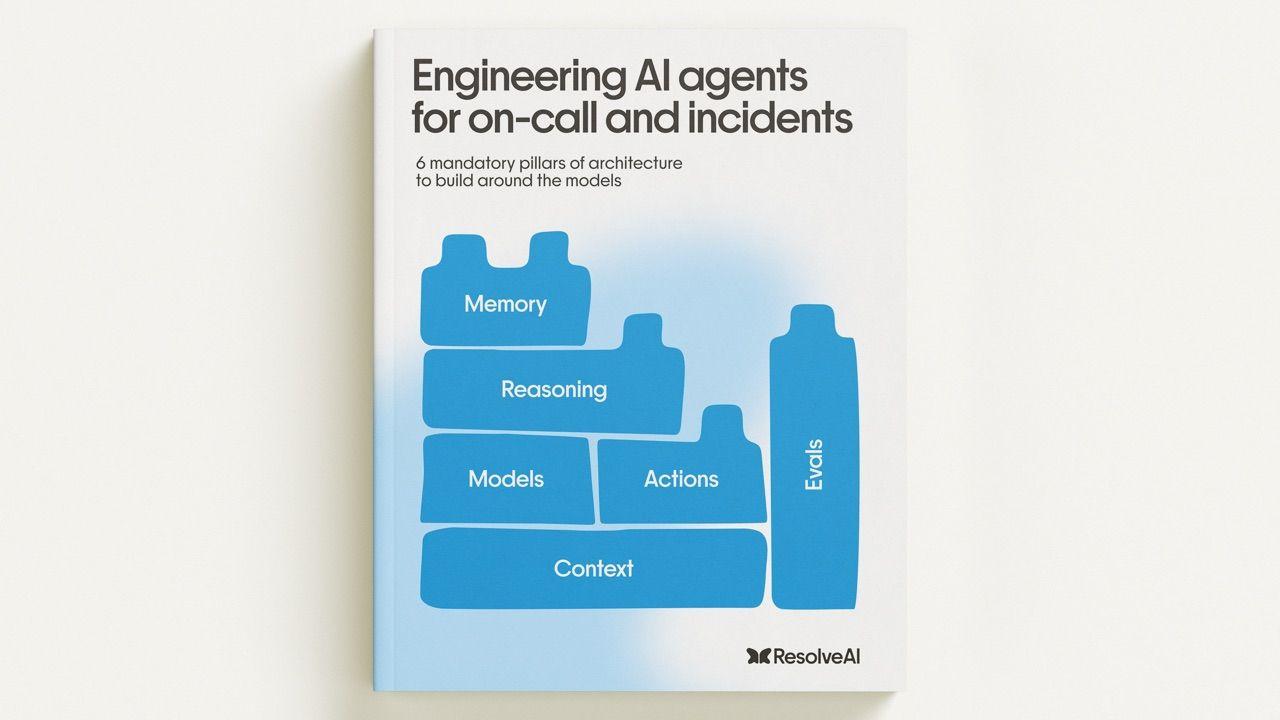
Context is the specific knowledge an AI SRE uses, alongside the world knowledge in its models, to get to the root cause of a given alert. It's how the agent knows what information to navigate during reasoning. Here, we go through what that context covers, why investigations fail without it, and how a standing context graph stays current.
Model orchestration is how automated RCA assigns the right model to each task in an investigation, so the system reaches a verified root cause fast enough and cheaply enough to run on every alert. Here, we go through what investigations demand of a model, why no single model covers the job, and where post-training fits.
LLM Evals are the tests that measure whether an AI's investigations actually reach the right cause, scored against real cases with known outcomes. Here, we go through why coherent answers fool people, what evals need to do for AI that investigates production failures, and how evals set the path to autonomy.
A harness is everything built around the model that turns the model’s intelligence into capabilities that drive investigations to root cause: context, tools, reasoning structure, guardrails, a learning loop, and evals. Here, we go through what a harness is, why it determines investigation quality, and what a production-grade one contains.
A guide to AI SRE tools: categories, capabilities, real user reports, and implementation considerations for engineering leaders.