







Delegate on-call to agents
Your on-call engineers start every shift with answers, not alerts
Participates in every on-call rotation
Autonomously investigates alerts and builds initial findings before the on-call engineer is paged
Investigations
Agents on every on-call rotation — triaging and investigating alerts in real time.
Scrape Error Rate High: errors > 2% across 2 orgs on same integration
Demo Org not Replying in Slack
High Alert Reception Latency (p90 > 10 mins over 20 min window)
RDS High Read IOPS: Instance is experiencing high read IOPS
Triages and investigates your alerts
Correlates signals across your observability stack, assesses severity, and identifies blast radius with evidence
Transient metrics provider outage (HTTP 500) causing scrape failures
Alert firing due to stale NoData KeepLast state
2 orgs with persistent UNAUTHORIZED errors due to missing events_read scope
Runbook conclusion
The metrics provider API had a transient outage affecting 27 orgs' alert scrapes in orders-prod-cluster. The error spike was brief and self-resolved; the alert fired late because of stale evaluation. No action required — this is provider-side.
Alert Details
- Breach: up to 4 orgs exceeded the 2% error rate on the metrics-provider integration in orders-prod-cluster.
- Timeline: spike at 9:54pm, peaked at 4 orgs at 9:59pm, back to baseline by 10:10pm. Alert fired at 10:26pm.
Impact
- Blast radius: 27 orgs affected by transient API errors on scrapeType=alerts.
- Customer-facing: none — spike resolved before page-load impact.
Resolves alerts without changing context
Silences noise, executes GitHub Actions, and routes to the right team. Engineers approve or let agents handle known patterns autonomously
Silence alert: Checkout p95 latency above threshold
pendingSilence Alert
Silence alert "Checkout p95 latency above threshold"?
This will create a silence in your monitoring platform immediately.
The following actions will be performed:
Silence Alert
Available in your collaboration tools
Findings, priority lists, and actions surface in Slack, MS Teams, CLI, Resolve AI, or your own agent
Missing schema migrations on orders-db causing transaction rollbacks. Rollback ratio crossed 2% threshold at 08:19Z.
Top 3 priorities
- Apply
orders-dbmigrationshigh - Investigate checkout p95 spikemed
- Review
checkout-v2revert PRlow
Used and loved by engineers
Removing the toil of investigations, war rooms, and on-call.
“Resolve AI allowed us to move from hours to minutes for investigations in many incidents. We pull fewer engineers into war rooms, on-call is materially better, and that translates directly to advertiser trust and revenue protection for a billion-dollar ads business.”

“Resolve AI proved it could deliver real results in a constrained environment. It identified dependencies, surfaced accurate root causes 72% faster than our teams, all while integrating cleanly into our existing stack.”

“Resolve AI has changed how our teams work through production incidents. What used to take hours of manual investigation and coordination across teams now gets resolved in a fraction of the time. Our engineers aren't only faster, they're focused on the work that actually drives impact.”

“We’ve seen the value of AI in development, and now we’re applying that same approach to production. We started by partnering with Resolve AI for alert triage, incident investigation, and root cause analysis. We’ve seen positive signs of improvement in mean time to resolve for our critical incidents, and the North Star is self-healing systems.”

“What excites me most about Resolve AI's background agents is that I’m no longer starting from zero. The alerts are already investigated. The deployment summaries are already written. The findings are verified and the next steps are waiting for me. A lot of the operational work I used to handle manually is now happening continuously in the background with my oversight. I’m still making the important calls, but I can operate at a scale that just wasn’t possible before.”

“Resolve AI feels like a teammate who’s already done half the work. It tells me immediately if something’s critical or can wait, saving countless hours and frustration.”

“Resolve AI helps my team navigate incidents by correlating signals across logs, metrics, traces, and code automatically. Instead of switching between multiple platforms hunting for clues, we get immediate context. At our deployment velocity, that speed makes all the difference.”

“Incident response at our scale isn't about collecting more signals. It's about understanding why something is failing, quickly enough to limit customer impact.”

Recent updates.
- May 2026
Autonomous alert triage
Every alert investigated automatically, 24/7.
- May 2026
Alert resolution
Agents take action directly, including silencing and GitHub Actions.
- May 2026
Deployment monitoring
Agents watch rollouts and investigate before alerts fire.
- April 2026
Adaptive learning
Triage quality improves with agent teams and engineer corrections.
Frequently asked questions
Resolve integrates with PagerDuty and other alerting tools. When an alert fires, Resolve picks it up automatically and begins investigating.
No. Resolve joins your rotation. Engineers stay on the loop and make the final call on high-severity issues. Agents handle the investigation so engineers start with context, not a blank screen.
Engineers review every finding. When they correct the agent's reasoning, those corrections become reusable knowledge. The system gets more accurate over time.
You define the boundary. Guardrails control what agents can do on their own versus what requires engineer approval. You set the rules.
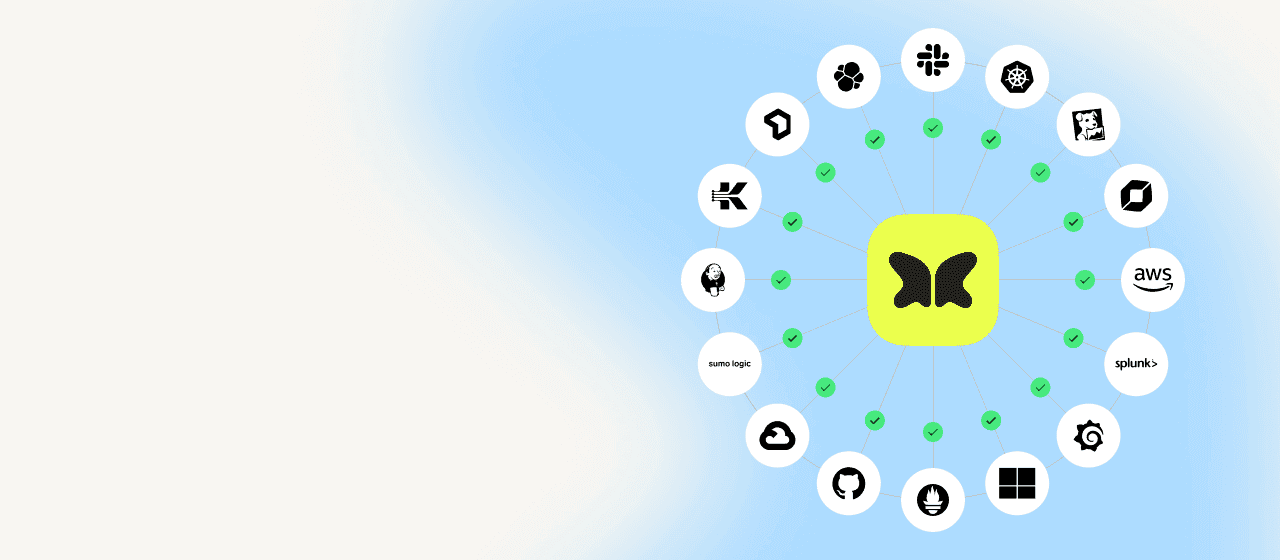
Datadog, Grafana, Prometheus, OpenTelemetry-based systems, and more. Resolve understands each tool's query language and data model.
Alert correlation groups related alerts. Resolve investigates them. It tells you why they're happening, with evidence from across your stack.
