






Loading the page…

See the agents that run and fix software in action
Join our engineering leads for "Behind the Build", a webinar series deep-dive into how we built agents that run software.
Because there was no agreed way to evaluate what an agent actually produced. Tokens are countable and outcomes were not, so consumption became the scoreboard by default. A token count tells you how hard a model worked on a problem. It tells you nothing about whether the problem got solved, and for anyone running agents against production systems that second question is the only one with a budget attached to it.
Token efficiency is the least number of tokens you can spend per completed outcome. The definition only works if the outcome is a specific unit of work rather than a vague notion of usefulness. For Resolve AI the units are investigating an alert and getting you to the root cause of an incident. Fixing the outcome as the denominator means the number moves only when the agent gets better at reaching the same conclusion with less work, which is the property you want to optimize against. Cost per investigation becomes predictable, and quality gets measured on its own terms rather than being inferred from spend.
Context. The token bill is won or lost on what the agent decides to look at, how much of it it pulls into the window, and how many times it goes back for more. Two agents can run on the same model against the same incident and end up with very different costs, entirely because one made precise calls into code, infrastructure, and telemetry while the other pulled broadly and repeatedly.
The useful way to picture it is a detective.
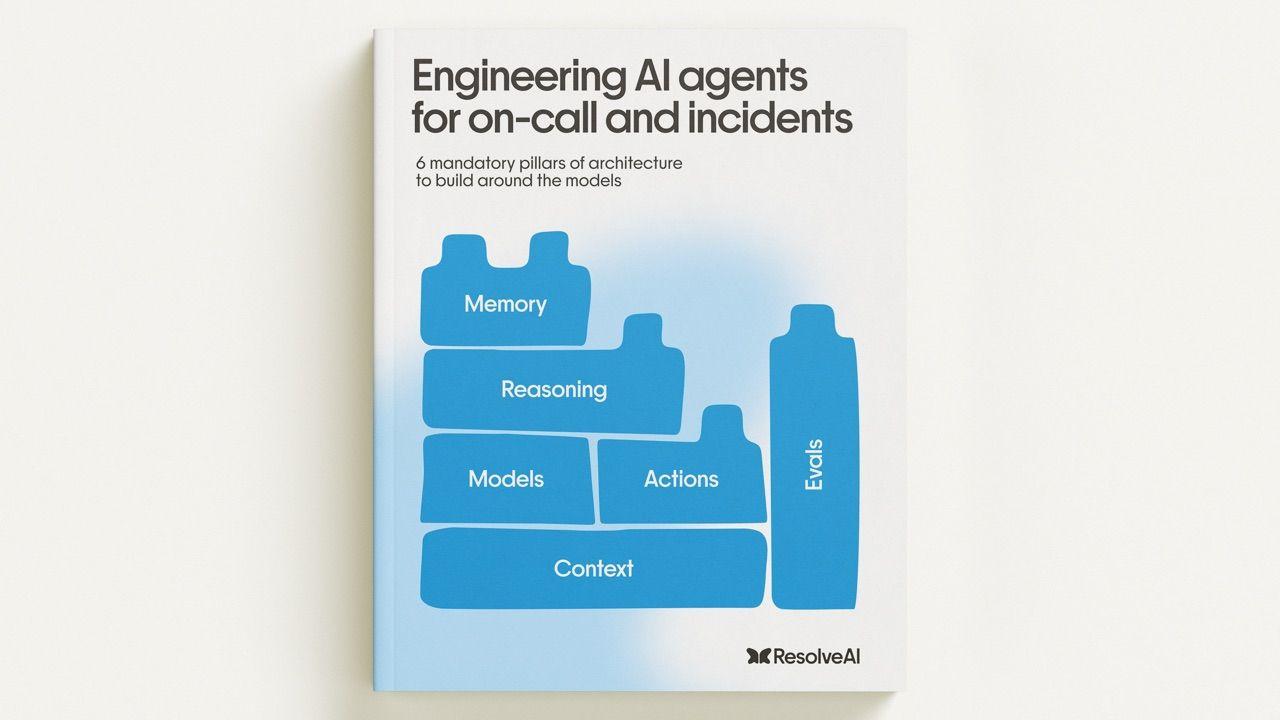
AI for prod ebook
Learn how top engineering teams use AI to run production.

Machines on-call for humans
A good one works from a map of the city. It knows which sources matter for this class of problem, asks different kinds of questions across code, infrastructure, and telemetry, and stops when the evidence converges rather than when it runs out of places to look.
Plot agent quality against the amount of context you give it and the shape is a hill, not a line.
Three things carry most of the weight.
Because the vendor should carry the token risk, not the customer. Resolve AI charges for the amount of work completed, which means every inefficiency in the agent comes out of Resolve AI's margin rather than a customer's invoice. It is also the pricing model that keeps the research incentive honest. If a better retrieval strategy halves token spend on an investigation, that is a direct gain. If the agent over-explores, that is a direct loss.
The line item gets sized against work rather than consumption. A platform team budgeting for incident investigation can plan against the number of alerts and incidents they expect to handle, without modeling token spend per investigation or padding the number for a month where the agents run hot. How many tokens an investigation costs stays Resolve AI's problem.