Loading the page…

Machines on-call for humans
Machines on-call for humans

Compare AWS DevOps Agent and Resolve AI on architecture, models, integrations, cloud coverage, and pricing. See why teams running on AWS add Resolve AI for production.
If you run on AWS, DevOps Agent is the most logical way to explore what an AI SRE can do. It's built into the console, Support credits could cover most or all of the bill, and it handles initial, basic needs well. Running and scaling in production is a different job: root causes far from the alert, findings the next engineer on call needs, and clouds beyond AWS. That's the work Resolve AI is built for.
Built on Amazon Bedrock AgentCore, DevOps Agent covers four jobs:
Both Resolve AI and AWS DevOps Agent connect to your observability tools, investigate incidents, and keep engineers approving fixes. In practice, the differences show up in four places:
| AWS DevOps Agent | Resolve AI | |
|---|---|---|
| Agent architecture | Multi-agent investigation on Bedrock AgentCore: triage, investigation, mitigation planning, and prevention over an application topology graph. Write access is limited to tickets and support cases; engineers execute the fix. | Multi-agent system that reasons over a live knowledge graph of your environment and is continuously optimized to create the best of quality, cost, and latency. Parallel-hypothesis investigation across code, infrastructure, and telemetry, with remediation plans and PRs gated on engineer approval. |
| Model and training | Amazon Bedrock foundation models. | SOTA models plus Resolve AI Labs' own models, post-trained for production engineering: causal reasoning, verification, and simulation. |
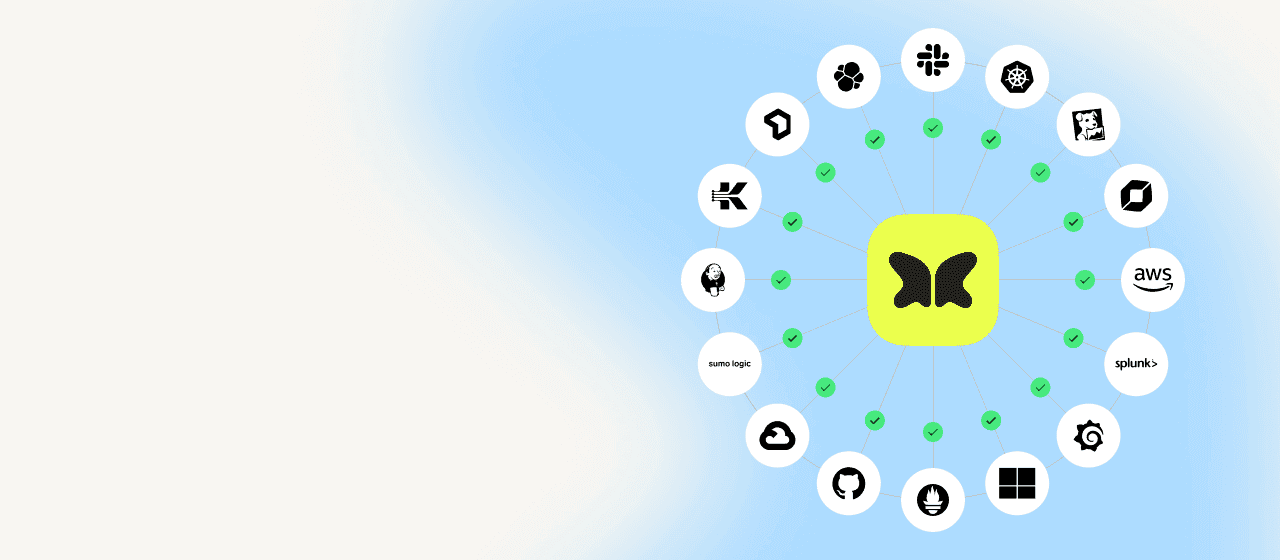
| Integrations | Integrations include CloudWatch, Datadog, Dynatrace, New Relic, Splunk, Grafana, Managed Prometheus; GitHub, GitLab, Azure DevOps; ServiceNow, PagerDuty, Slack, Teams; custom MCP servers. | Integrations include Observability (Datadog, Splunk, Grafana, Prometheus, OpenSearch, CloudWatch), cloud and Kubernetes down to the pod, GitHub, and Slack, connected through MCP, APIs, and webhooks with read-only, least-privilege access. |
| Cloud coverage | AWS-native. A light Azure integration via Microsoft Entra ID; No native GCP. | AWS. GCP. Azure. K8s/hybrid. Cloud-neutral by design, with full AWS service coverage through IAM: ECS, EC2, RDS, EKS, CloudWatch, CloudTrail, and more. |
| Pricing model | Unpredictable per agent-second with no cap on what a long investigation can cost. | Predictable, task-based pricing easy to forecast against alerts and incidents |
| Named proof points | Western Governors University, 77% faster MTTR. Deriv, over 40%. Zenchef, 75%. United Airlines and T-Mobile are also named customers. | Over 15 named customers including: DoorDash, 87% faster to root cause. Coinbase, 72% faster critical-incident investigation. Zscaler, 75% faster with 30% fewer engineers per incident. |
| AWS commitment drawdown | Billed against existing AWS commit. | Available on AWS Marketplace to leverage your existing AWS commitment. |
| Build with agents | Release Management (in preview) hands agent-ready specs to Kiro or Claude Code for implementation. | Available over MCP in Claude Code, Codex, and Cursor, bringing production context into the coding agent you already use. Remediation PRs today, on a path toward closed-loop fixes. Custom agents can be built on the same platform. |
Resolve AI was founded by co-creators of OpenTelemetry, observability's open standard. The team at Resolve AI Labs includes engineers from Google DeepMind and Meta Superintelligence Labs, training models specifically for production engineering.
Resolve AI is the closest direct alternative. Both investigate incidents autonomously and keep engineers in control of fixes. The difference is the architecture behind the investigation. Resolve AI pairs frontier models with its own post-trained models, grounds them in a knowledge graph of your environment, coordinates multiple agents through causal reasoning, acts within guardrails and scoped autonomy, and learns from both explicit feedback and implicit signals. A domain-specific eval framework, calibrated to mirror how engineers actually investigate, tests all of it against every new model release.
Usage-based: $0.0083 per agent-second, which works out to about $0.50 per minute of run time. AWS publishes worked examples, roughly $40 a month for 10 short investigations and $320 for 80, and there's no published cap on what a single long investigation can cost.
Resolve AI prices based on a predefined credit-based model per task on an annual basis, scoped to your environment, and is available through AWS Marketplace.
Three things. Models: DevOps Agent runs on Amazon Bedrock foundation models, while Resolve AI pairs foundation models with its own, post-trained model for production engineering. Knowledge: both persist context, but DevOps Agent scopes its topology graph and investigation history to each agent space, isolated per team or service, while Resolve AI maintains a knowledge graph that carries findings, dependencies, and context across teams and into every future investigation. Coverage: DevOps Agent natively investigates AWS and Azure with no first-party GCP connector, while Resolve AI runs across AWS, GCP, Azure, and Kubernetes.
Partly. It natively investigates Azure resources through Azure Resource Graph, covering VMs, AKS clusters, databases, and networking, and correlates Azure DevOps deployments with incidents. It also reads third-party observability tools like Datadog and Splunk wherever they run. There's no first-party GCP connector documented, so GCP workloads are reachable only through those observability tools or custom MCP servers.
Resolve AI was built cloud-neutral from the start, investigating AWS, GCP, Azure, and Kubernetes. For teams running on GCP or across clouds, that's usually the deciding factor.
Book a demo to walk through a live investigation, then scope a pilot on your own environment.
Stay current on how the best engineering teams are using AI in production. Customer spotlights, product updates, how-tos, and more delivered monthly.