





Back
7 min read
Agents that run your software
Written by
 Mehul GoyalMember of Technical Staff
 Steven KarisChief Architect & Founding Engineer
 Milind GanjooMember of Technical Staff
- Topic
- Product
Today, we’re shipping new capabilities that make Resolve AI the platform where engineering teams run and fix production software with AI agents. New capabilities include background agents that run operational tasks, a new agent architecture that delivers 2x investigation quality, new agent capabilities like governed actions, and new ways to work with agents in UI or terminal.
With Resolve AI, engineering teams can now delegate on-call to agents, co-work with agents to resolve incidents, and run operational tasks with background agents.
Delegate on-call to agents
Enterprises like Zscaler receive more than 150,000 alerts a month. That volume of alerts has to be assessed, ruled out, routed, or investigated, which makes on-call rotations the largest drain on engineering time.
Resolve AI's on-call agent participates in every rotation. With the new Triage mode (currently in early access), it runs an initial assessment on every alert as it fires and provides clear guidance for the on-call engineer: silence the alert, execute a predefined action, route to the right team, or continue investigating. Engineers see this work in Slack, MS Teams, and the tools their teams already use.
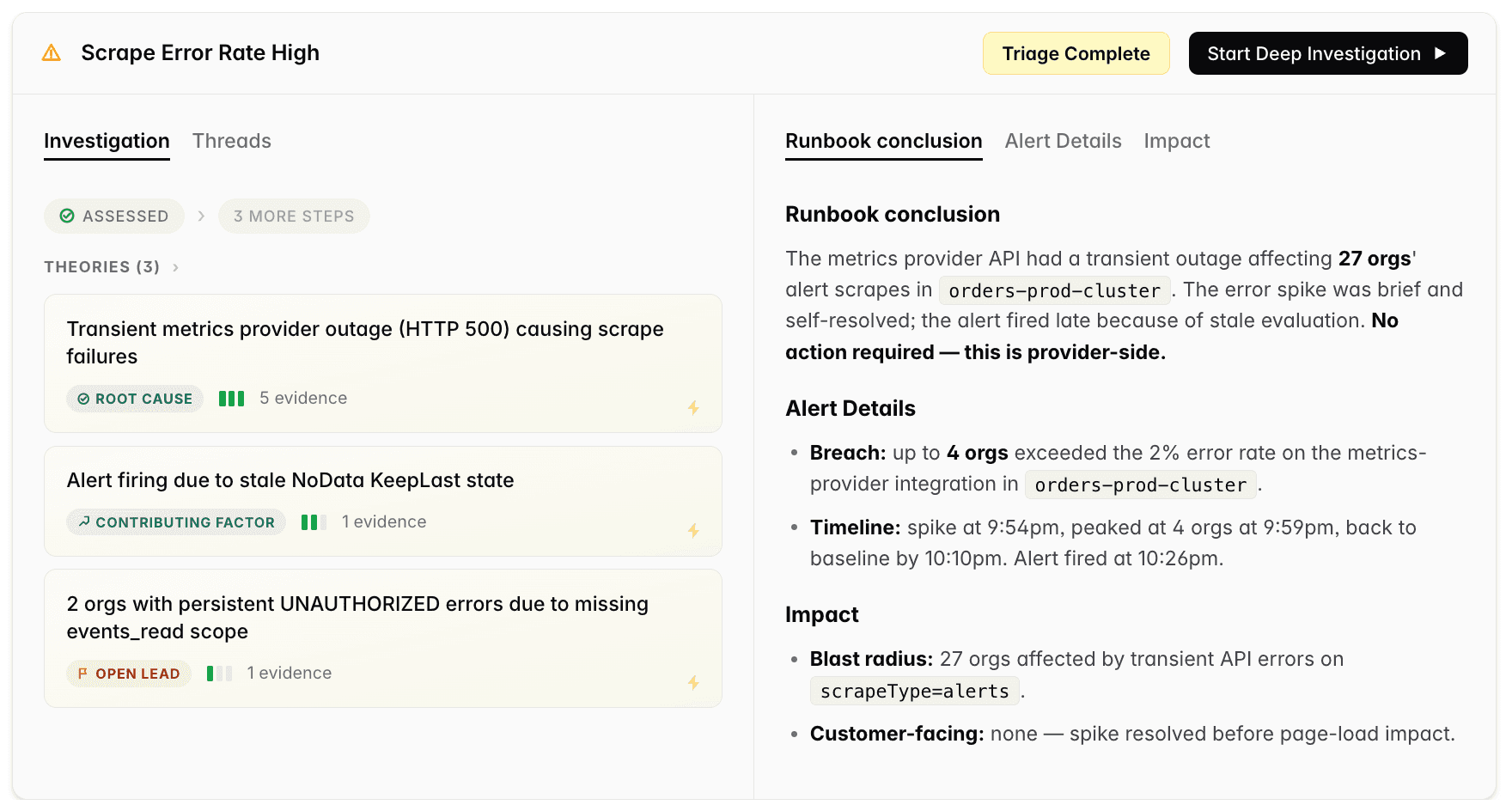
The shifts how engineers handle increasing alert volume. The agent runs the assessment on every alert, and the on-call engineer steps into action. For alerts that require further investigation, the engineer can engage a team of agents to drive the investigation.
Learn more about the on-call agent here →
Co-work with agents to resolve incidents
Production incidents span multiple systems and rarely surface where the root cause actually lives. As Alex Danilychev, from Doordash described it, "It's painful when you know there’s a problem impacting your customers but you don’t know where it’s coming from.” Resolving these incidents pulls multiple subject matter experts into bridge calls to stitch context together under time pressure.
Resolve AI's incidents agent investigates alongside engineers. A team of domain-specialized agents pursues multiple hypotheses from different starting points and converges on root cause through evidence. In internal evaluations, the new architecture delivers more than 2x improvement in root cause quality of the prior model - the same model that helped customers like DoorDash reduce time to root cause by up to 87%.
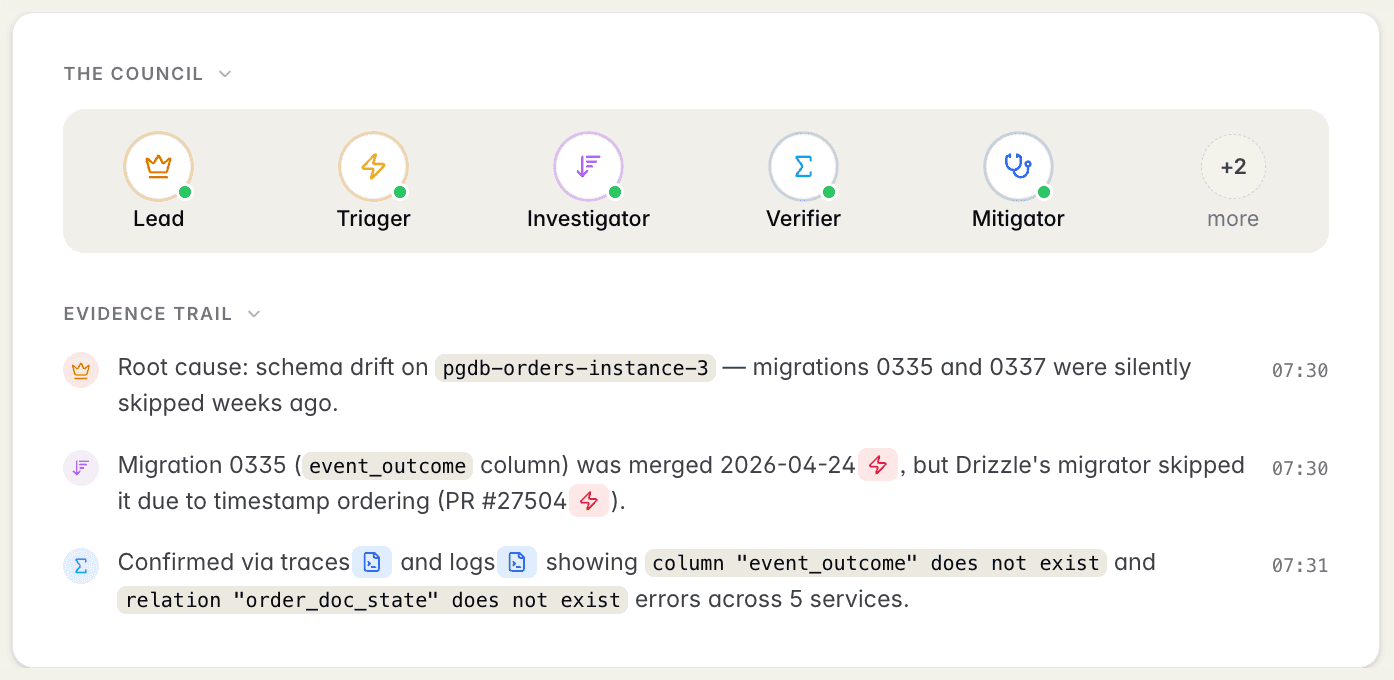
With the new Resolve AI Workbench, engineers and agents collaborate on a shared investigation surface using the same evidence. Engineers can trace which hypotheses agents are pursuing and the evidence behind each finding. They can also run their own investigation alongside the main one, alone or with their team, and steer agents in a new direction when they uncover new evidence. Evidence is embedded directly in the report, so engineers can pull and modify the source queries or execute actions without leaving Workbench.
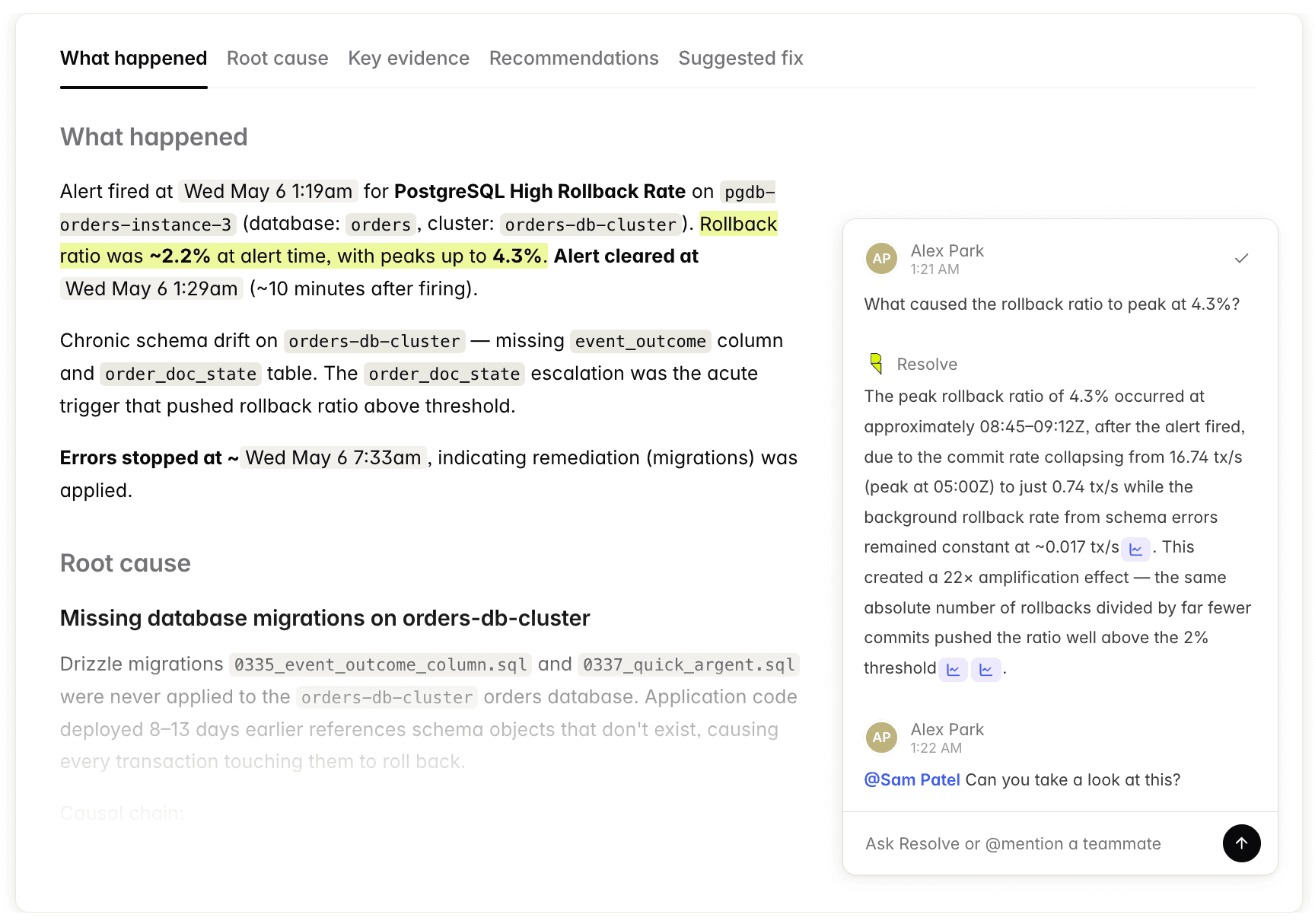
Instead of engineers serializing the work and waiting on specialists, a team of agents runs the investigation in parallel. Workbench becomes a shared surface where teams of engineers and agents work together, or amongst themselves, in parallel.
Learn more about incident agent here →
Run operational tasks with always-on background agents
Every day, engineers spend hours on the work that keeps production healthy: monitoring deployments, analyzing anomalies, generating reports, and reviewing resource usage. Together, these tasks consume meaningful engineering time, and they require engineers to be always available to run them.
Resolve AI's new background agents handle this work continuously. They run on a schedule, on event triggers like deployments or alerts, or on demand. With the new chat experience, engineers can spin up a background agent the same way they'd prompt any agent, and follow up on findings in the same conversation to debug live or trigger ad hoc workflows.
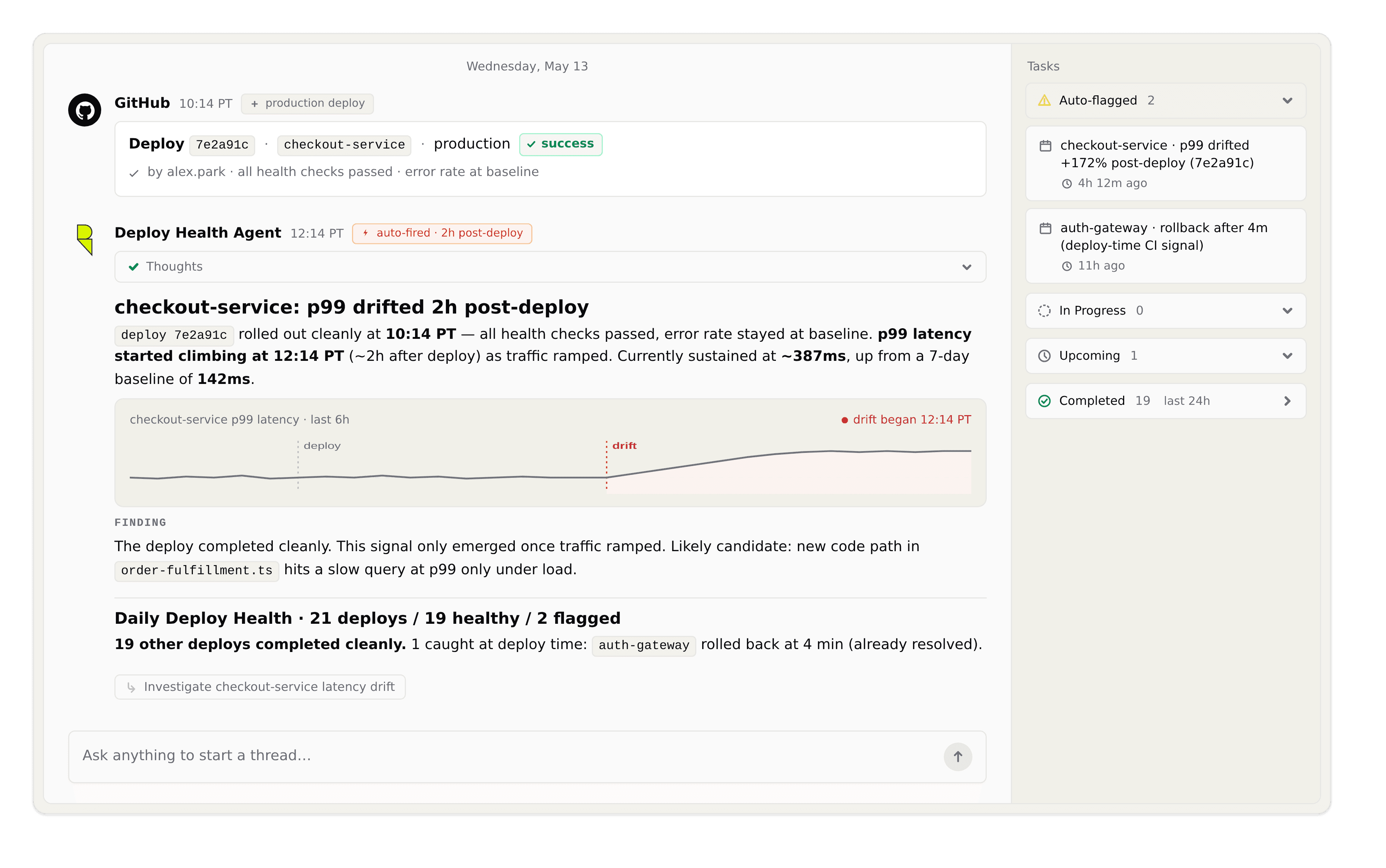
With background agents running, you start your day with a prioritized list of what they have already investigated, along with verified findings and recommended next steps. The execution happens in the background, and you step in to review, debug, or approve.
Background agents are a new surface for us, and we'll be expanding what they can do as more engineering workflows move into the always-on pattern.
Learn more about background agents here →
Bring Resolve AI capabilities to your agents
Agents are an extension of how engineering teams do their work, which means every team and every org needs them shaped differently. But building production-grade agents takes real engineering effort: picking the right model for each job, building a harness that delivers quality, getting the context right, and meeting enterprise security requirements. Most teams don't want to do this from scratch for every workflow.
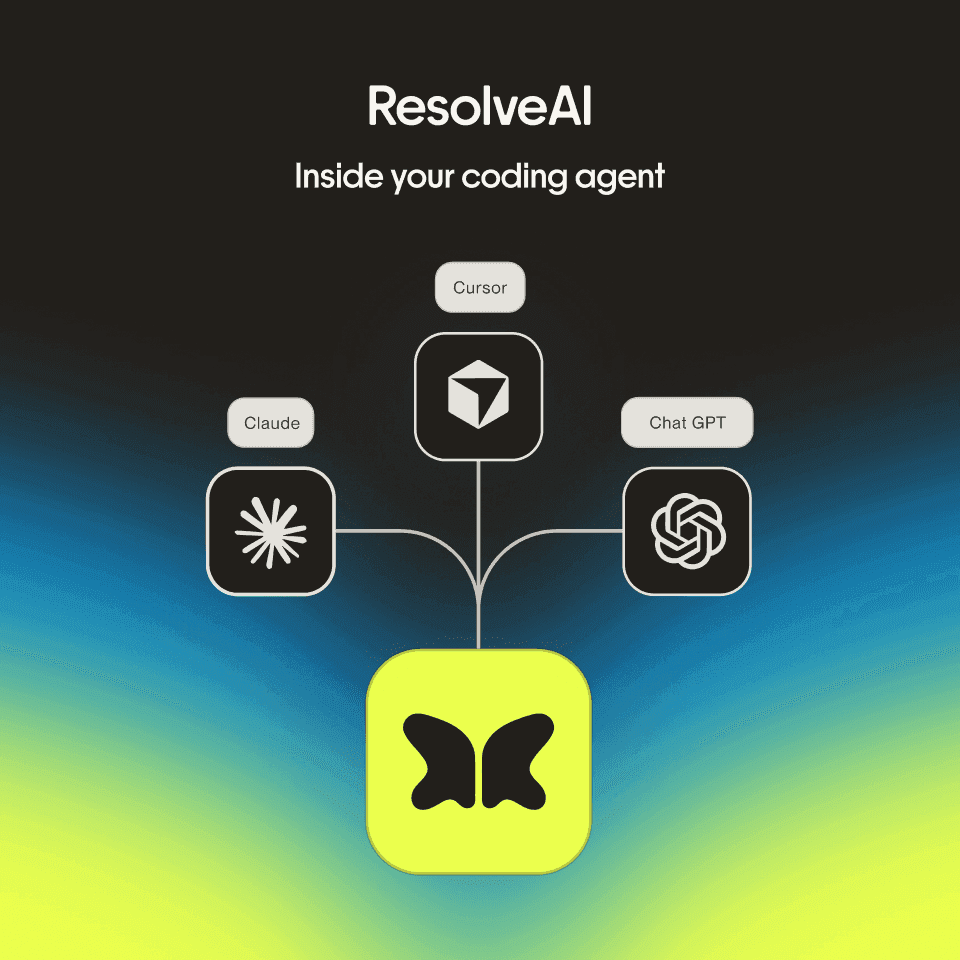
Resolve AI capabilities are available as an MCP server, a public API, and composable Skills, so engineering teams can plug Resolve into their existing agent ecosystems. The AI systems your team already uses can call Resolve's investigation capabilities directly.
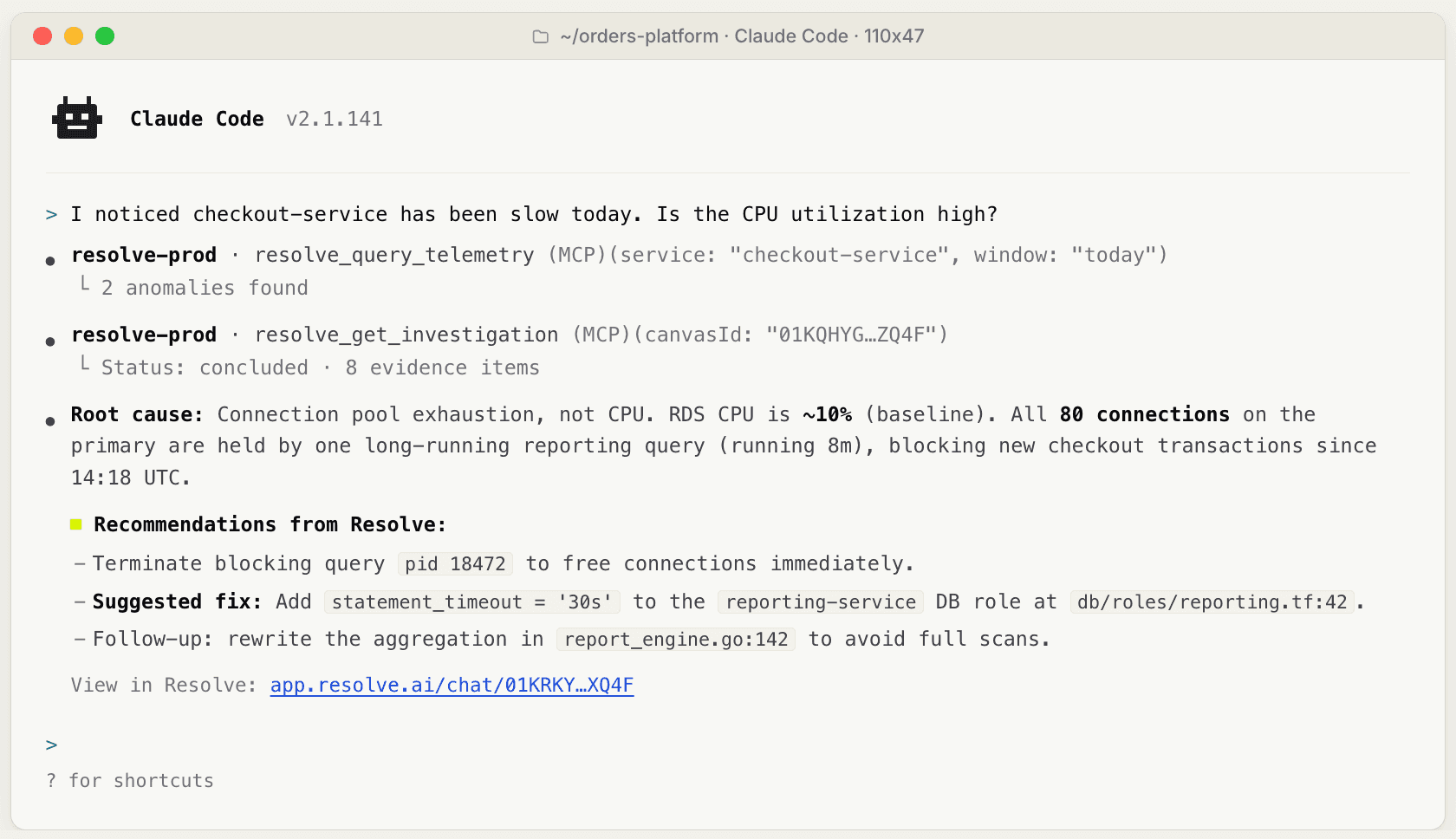
Resolve AI agents consume your internal skills and knowledge so investigations run with the full context of how your systems actually work. Codifying your team's expertise into Resolve turns the managed agents into a multiplier on the rest of your work.
Combining your team-specific expertise and nuances from your skills with Resolve AI's agent infrastructure (models, harness, context, governance) gets you the best agent for the job. Engineering effort moves to where it's differentiated.
Learn how you can customize your agents here →
Platform powering the agents
Every Resolve AI agent runs on the same platform. Each layer is a hard problem on its own, and they have to compose for any of them to matter.
Models. Frontier models alone don't reason well enough about production. Resolve AI pairs managed frontier models with domain-specialized models post-trained on production data, and picks the best model for each task. As frontier models release every few weeks, Resolve AI absorbs the orchestration changes that come with each one and runs continuous evals to catch regressions and keep quality climbing.
Context. Production data sits in fragmented tools, tribal knowledge sits in engineers' heads, and the topology changes daily. Resolve AI maintains a queryable graph of services, dependencies, deploys, and team knowledge that updates continuously. Every investigation feeds it back: engineer corrections become reusable skills any agent can retrieve.
Governed actions. Operating a tool well is its own expertise: the right queries, the right sequencing, knowing the rate limits and gotchas. Resolve AI carries that expertise across every connected tool. It acts on production within guardrails you define, including silencing alerts, reverting commits, opening PRs, and executing GitHub workflows.
Integrations. Production work spans dozens of tools, and the connections between them are where investigations actually happen. Resolve AI ships with 60+ pre-built integrations across code, infrastructure, observability, incident management, and CI/CD. Schema changes, auth rotations, and rate-limit handling are Resolve AI's maintenance burden, not your team's.
Security. Production actions need guardrails before agents take them. Resolve AI lets you define what runs autonomously and what requires approval, with permissions scoped across org, team, and individual levels. SOC 2, GDPR, and HIPAA aligned, with security controls applied across every layer of the platform.
Building any one of these is hard engineering work. Building all five to work together is what makes a platform, and what makes Resolve agents able to do real work in production.
What customers are seeing
DoorDash uses Resolve across the Ads platform. "We've been using Resolve AI to investigate alerts and incidents across our Ads platform, and performance has been strong and useful. Their new architecture of using teams of agents promises even better results. And the new Resolve AI Workbench gives our team of engineers and agents a collaborative canvas to work on the same investigation in real time."
- Alex Danilychev Jr, Engineering Manager.
Gametime uses background agents to run operational work proactively. "I'm no longer starting from zero. The alerts are already investigated, the deployment summaries are already written. I'm still making the important calls, but I can operate at a scale that just wasn't possible before."
- Jeff Aronhalt, Principal Software Engineer.
Zscaler builds custom investigation agents on top of Resolve. "For server-side investigation, my team uses Resolve AI. I built the classifier, the error code mapping, the probe logic for our customer journeys, and Resolve AI runs the investigation across our code, infrastructure, and telemetry."
- Mike, Senior Staff SRE.
Getting started
Resolve AI is available today. Request a demo at resolve.ai or contact your account team to get access to the new capabilities.
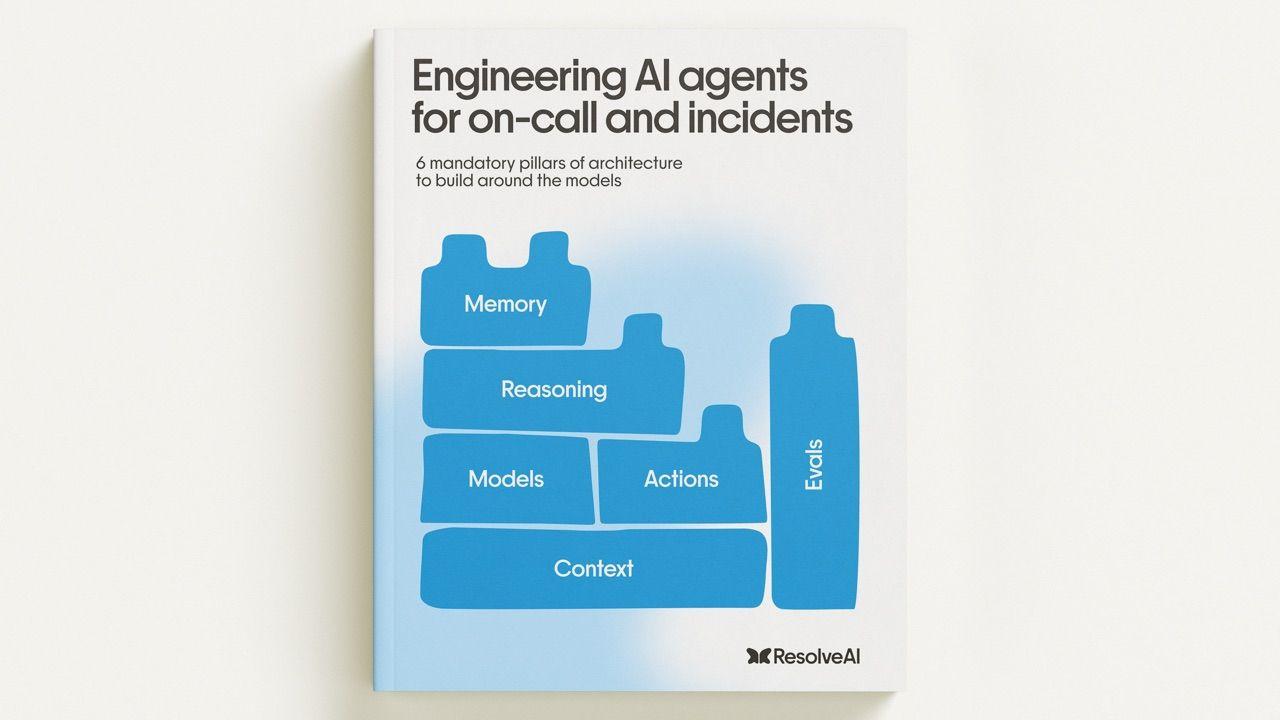
AI for prod ebook
Learn how top engineering teams use AI to run production.
See the agents that run and fix software in action
Join our engineering leads for "Behind the Build", a webinar series deep-dive into how we built agents that run software.