






What is Automated Root Cause Analysis?
Automated root cause analysis is an investigation method using software that generates hypotheses, chooses the evidence that separates them, and eliminates alternatives until the issue is traced from a trigger to what caused it.
Automated RCA runs that method on production issues, from full outages to performance degradations. It correlates logs, metrics, traces, deploys, and config changes, and produces evidence-backed root-cause conclusions in real time, while the alert investigation is live rather than after the fact. It runs on the telemetry you already have, as a layer over your observability stack rather than a replacement for it. And the autonomy is scoped to the investigation. The agent investigates on its own, and the fix waits for a human.
Say an alert fires at 2 am. The root cause is buried somewhere across logs, metrics, traces, recent deploys, and five dashboards, and the on-call engineer has to find it.
That search is where incident time goes. Most of MTTR is spent finding the cause. Once the cause is known, the fix is often quick, a rollback or a config change.
Automated RCA can bring that number down, but only if it holds up on real production incidents. Pointing an LLM at your logs works in a demo and breaks down once investigations get hard. Production needs models trained for troubleshooting, context about your systems, reasoning that tests hypotheses, guardrails on actions, a learning loop, and evals that measure investigation quality.
Key facts
- Automated RCA is an investigation method run by software: it correlates logs, metrics, traces, deploys, and config changes into evidence-backed root-cause conclusions during live alert investigations.
- Finding the cause, not fixing it, takes up most of an incident's duration.
- It runs on your existing telemetry. It doesn't replace your observability stack.
- The investigation is autonomous. Actions on production wait for human approval.
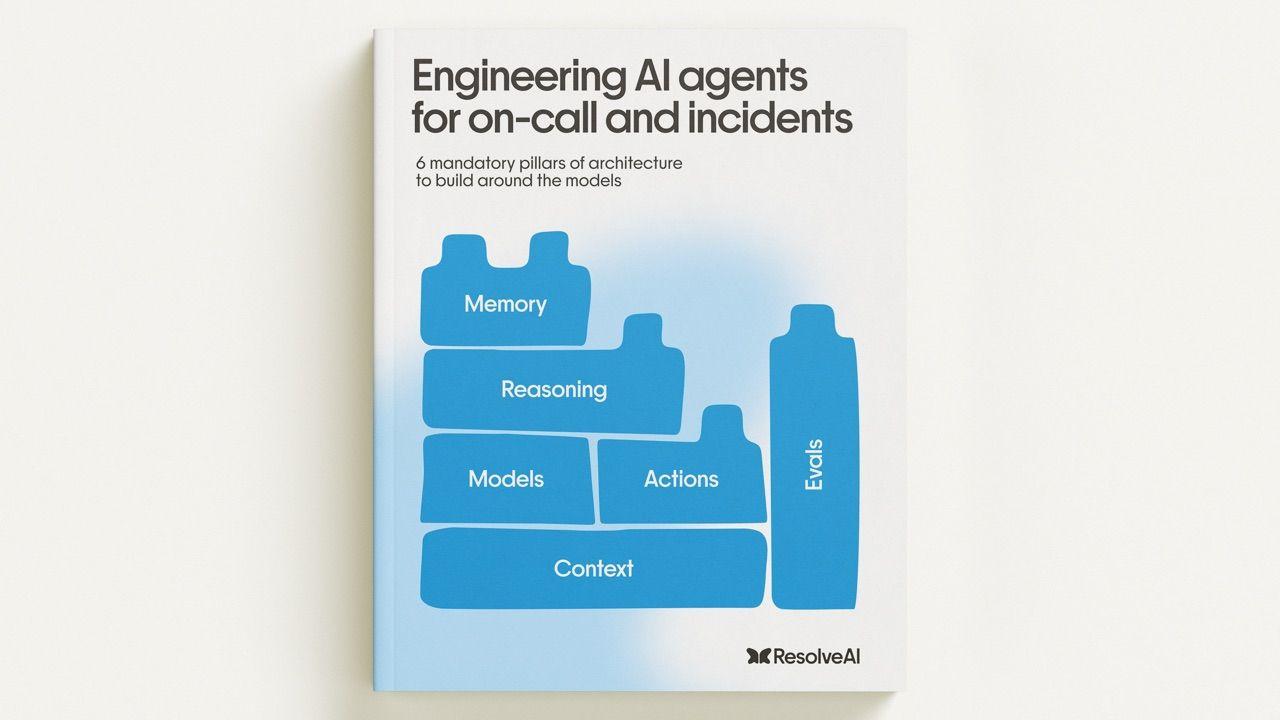
- A production-grade system requires six layers to work together: models, context, reasoning, actions, learning, and evals.
- Resolve AI customers report time to root cause reductions of 87% (DoorDash Ads) and roughly 60% (Salesforce).
How is automated RCA different from manual investigation of root cause analysis?
The timing separates it from traditional RCA. Five Whys and fishbone diagrams are post-incident rituals. They're useful for documenting what happened and recommending preventive actions, but they begin after the incident is resolved and depend on whoever's in the room remembering events accurately. Automated RCA takes a data-driven approach while the incident is still running, when finding the cause changes the outcome.
AIOps platforms like ServiceNow apply machine learning and workflow automation to IT operations. They handle anomaly detection and event correlation, compressing thousands of alerts into a few clusters and flagging that something unusual is happening. That narrows where to look, but a human still does the investigating.
Agents built on large language models (LLMs) changed what AI root cause analysis can do. They query observability tools, form hypotheses, and test them against the evidence, the way an engineer would.
| What gets automated | What that looks like | What the engineer still does | What you get |
|---|---|---|---|
| Nothing | Unassisted investigation across dashboards, logs, and code | The whole method | A cause, at the speed of one person holding one theory at a time |
| Evidence retrieval | Log search, natural language query over telemetry, observability copilots, alert and event correlation | Decides what to look for, holds the candidates, interprets each result, decides when to stop | Faster lookups and a narrower place to look |
| Evidence retrieval + response process | Incident orchestration: paging, channels, status pages, timelines | All of the investigation | A managed response, not an answer |
| Evidence retrieval + response process+ hypothesis loop | Automated RCA | Verifies the chain and decides the action | A chain from trigger to symptom with evidence at each link |
A team with a fast query interface over every production system is still doing manual root cause analysis. They have compressed the retrieval step, which was never the hard part. The engineer still generates the candidates, still picks the evidence that separates them, and still runs the loop one thread at a time at human speed.
Incident orchestration tools sit alongside automated RCA rather than competing with it. One runs the response, the other finds the cause.
Why does automated RCA matter now?
Break an incident into its parts and the time goes to one place. Once the cause is known, the remedy is often a rollback, a restart, or a config change. The long middle is finding out what's actually wrong. Most of the mean time to resolution is spent understanding the problem, and downtime costs scale with every extra hour that takes.
That understanding got harder to reach. A decade ago, an engineer could hold the whole system in their head: one codebase, a few dashboards, deploys every couple of weeks. Now there are hundreds of services calling each other, infrastructure that autoscales by the hour, deploys landing daily, and telemetry measured in terabytes. Sometimes, the answer to "what broke" exists in the data, spread across more sources than a person can check in the time available. Other times, it’s not even written down. The bottleneck shifted from collecting the data to reasoning across it.
Investigation skill doesn't spread evenly either. It's built on years of accumulated knowledge about the system, and it concentrates in the hands of a handful of senior engineers. When an incident gets hard, it escalates to them no matter whose rotation it is. They become the constraint on every difficult resolution, and the toil lands hardest on the people the team can least afford to burn out. Meanwhile the knowledge never spreads, because the engineers who could teach it are busy firefighting.
Each of these was manageable on its own. Together they compound, because investigation load keeps growing while the pool of people who can absorb it stays flat. Automating the investigation itself only recently became possible, which is why the category is emerging now.
Why does AI struggle to investigate production?
Teams that build their own investigation agent tend to see the same arc. It works in single-player mode, one engineer running simple investigations, and then collapses on real production incidents. Six reasons come up repeatedly.
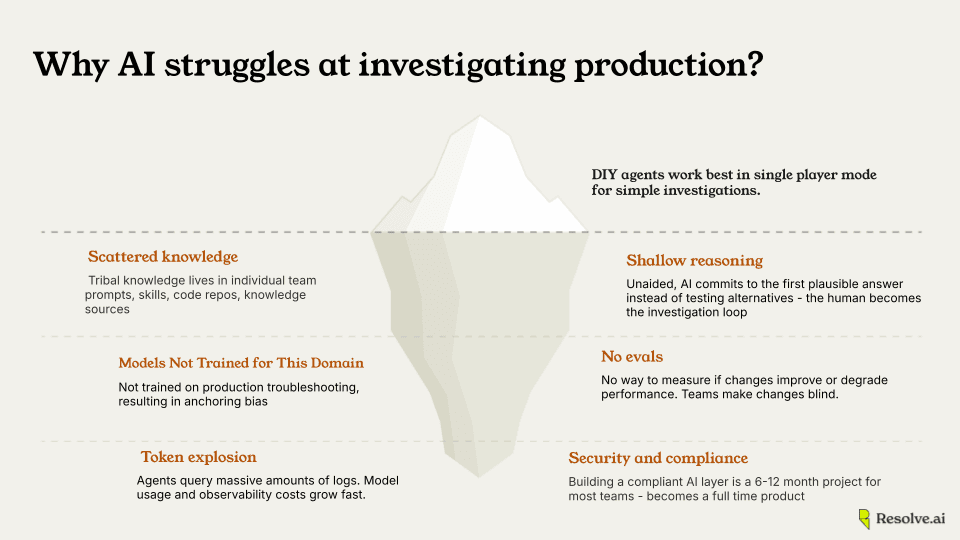
- Scattered knowledge. The knowledge an investigation needs lives in individual prompts, personal skill files, code repos, and people's heads. Each engineer's agent knows what that engineer taught it and nothing the rest of the team knows. It repeats work and misses context a colleague could have supplied in seconds.
- Shallow reasoning. Unaided, artificial intelligence settles for the first plausible answer rather than generating alternatives and testing them. The engineer ends up prompting every step, checking every claim, and steering the whole thing. The human becomes the investigation loop.
- Models not trained for this domain. Frontier models learn from code, docs, and general text. Almost none of that shows how production investigations unfold, because postmortems record conclusions, not the path to them. So models lean on pattern recognition, anchor on familiar-looking symptoms, and reach for the failure they've seen most often, whether or not it's what happened.
- No evals. There's no off-the-shelf way to measure whether a change to a prompt, a new tool, or a model upgrade made investigations better or worse. Teams iterate blind. Quality drifts, and nobody notices until an incident goes badly.
- Token explosion. Production telemetry data is enormous, and an agent that queries it naively pulls massive log volumes straight into the model. Costs blow up on both ends: model tokens and observability query fees.
- Security and compliance. An AI layer over production has to get scoped access, audit trails, and data handling right, and it has to satisfy whatever compliance regime you operate under. Building that properly is a 6- to 12-month project. At that point, the DIY agent has become a full-time internal product.
What does production-grade automated RCA architecture look like?
Six pillars, and each one exists because a specific part of the method breaks when you try to run it without a person.
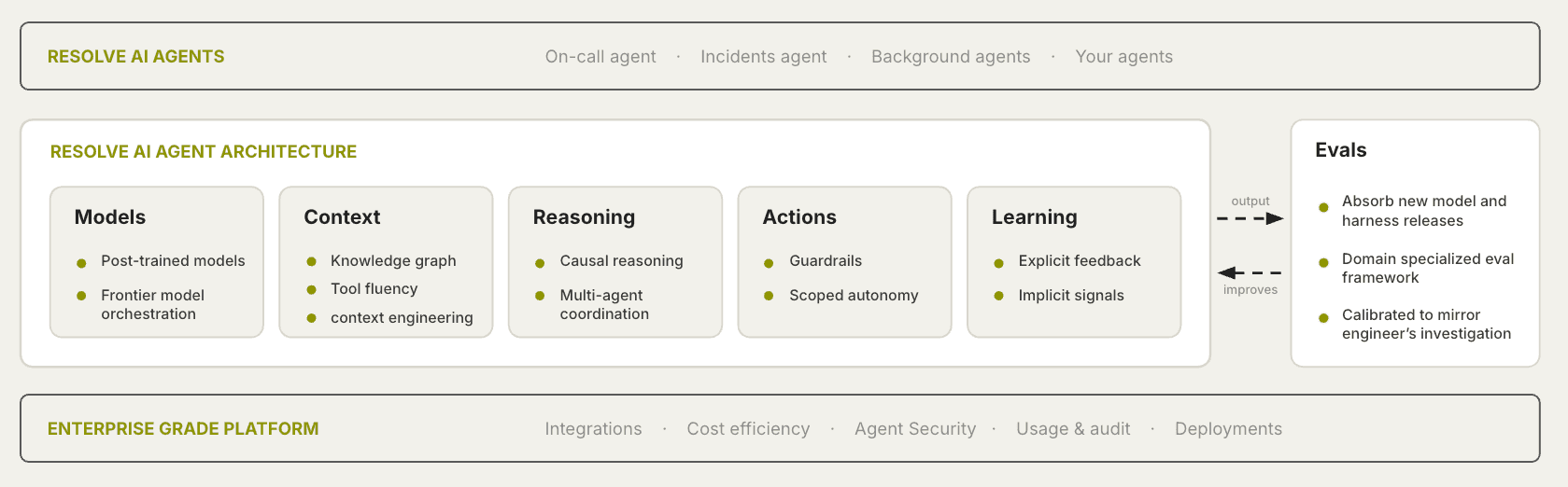
Models
Models post-trained on production troubleshooting, and orchestrated alongside frontier models. Post-training closes the domain gap, so symptoms map to real production failure modes instead of the nearest familiar pattern.
Context
A context graph of your systems, fluency with your observability tools, and context engineering that controls what enters the model's window at each step. The agent starts every investigation already knowing your services, dependencies, and recent code changes, and its queries stay scoped. That fixes both scattered knowledge and token explosion.
Reasoning
Causal reasoning and multi-agent coordination, with hypotheses tested in parallel. Instead of one thread committing to its first answer, the system generates alternatives, gathers evidence for and against each, and ranks what survives.
Actions
Guardrails and scoped autonomy. The agent investigates freely and reads widely, but acts only within explicit bounds, with an audit trail on everything it touches. That's what makes the security and compliance story workable.
Learning
Explicit feedback from engineers plus implicit signals from every investigation, folded back into what the system knows. Tribal knowledge becomes institutional memory, and each incident improves the next investigation.
Evals
A domain-specialized eval framework calibrated to how engineers actually investigate. LLM evals measure whether changes improve the quality of investigations, detects regressions, and allows the system to safely absorb new model releases.
Here's how a Resolve AI automated RCA investigation works through an alert investigation, step by step.
- First response and triage. Resolve AI's agents pick up the alert as it fires and start investigating before the on-call engineer even looks, drawing on the context graph they maintain of your services, dependencies, and recent deploys and code changes.
- Parallel hypotheses. A team of domain-specialized agents pursues multiple hypotheses from different starting points at once, gathering evidence across your observability tools, code, and infrastructure.
- Convergence on root cause. Each hypothesis is proved or disproved against the evidence, so the investigation converges on a root cause that's checked rather than asserted.
- Causal timeline and proposed fix. The engineer gets a causal timeline from trigger to symptom, with citations to the specific log lines, metrics, and changes behind each step, and a proposed fix. The investigation is autonomous. The fix waits for the engineer.
The causal timeline is the trust mechanism. Every finding is inspectable, engineers and agents work from the same live evidence, and the on-call engineer verifies the conclusion in minutes instead of hours. This investigation loop is also the core of what an AI SRE does.
The outcomes Resolve AI customers report follow from that. DoorDash Ads reduced time to root cause by up to 87% with Resolve AI, and Salesforce reduced it by roughly 60%. Fewer incidents escalate to senior engineers, and postmortems start pre-documented, because the investigation record already exists.
Should you build or buy automated RCA?
Building retrieval automation is genuinely fast. A capable engineer with tool access and a frontier model gets there in days, and for a single-service setup it can be enough. What that build does not give you is the loop. Candidate generation, discriminating evidence, elimination, and a chain that holds up all sit behind knowledge capture, evals, guardrails, and a compliant security layer, and each of those is its own workstream.
The cost sits in everything around the agent. Knowledge capture, evals, guardrails, and a compliant security layer each become their own workstream, and together they add up to an internal product that requires a full-time team. The real question is whether you want to build production AI infrastructure or spend that engineering time on your own product.
What should you look for in an automated RCA tool?
- Does it run the investigation or just speed up the search? Ask whether it generates and eliminates hypotheses on its own, or returns correlated events for an engineer to work through.
- Does it investigate during the incident, or summarize afterward? Post-hoc analysis helps the postmortem, but it doesn't shorten the outage.
- Does it show evidence chains and confidence for each hypothesis? An answer without evidence can't be verified, and engineers won't act on it.
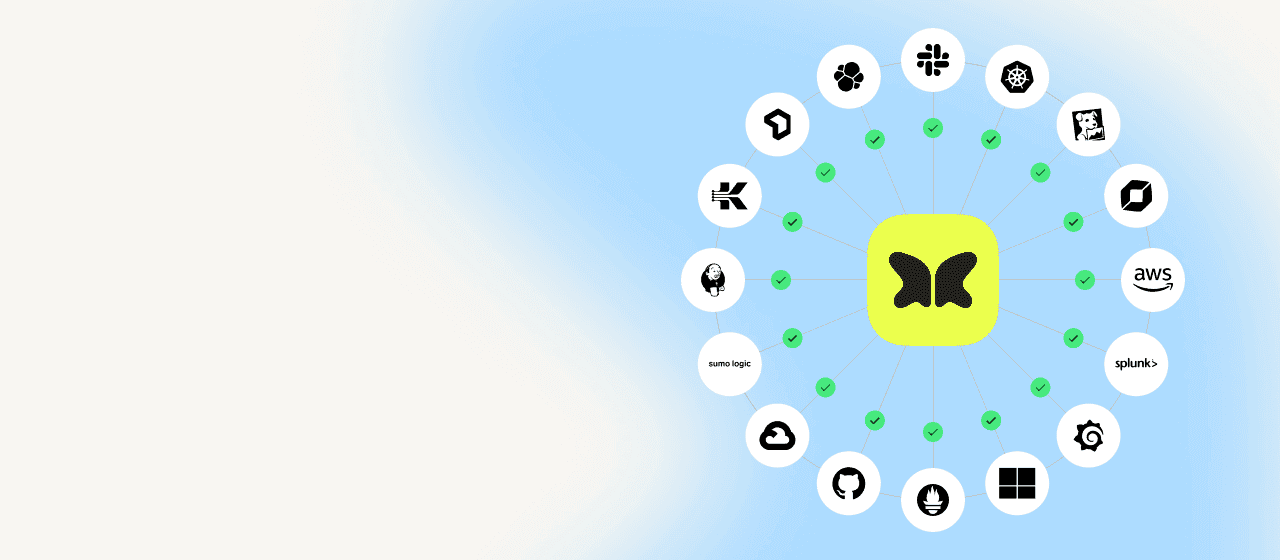
- How broad are the integrations? The agent needs to span your observability, deployment, and communication stack, including standards like OpenTelemetry, and it should fit into your existing incident-management workflow rather than replace it.
- Does it learn from your incidents? Investigation quality should improve with use, not stay flat.
- Can the vendor show how they measure investigation quality? Ask to see the eval approach directly.
- What's the security posture? Look for scoped access, audit trails, and deployment options that fit your compliance requirements.
- How does the cost model behave as telemetry grows? Pricing tied to log volume gets expensive exactly when your systems get busier.
Get to automated RCA on your own stack
The fastest way to evaluate this category is watching an agent investigate your incidents. Book a demo to see Resolve AI's agents on your systems, or start with the AI for Production Systems ebook for the full architecture behind them.
Frequently asked questions
Automated RCA is an investigation method run by software. It generates hypotheses, chooses the evidence that separates them, and eliminates alternatives until the issue is traced from a trigger to its cause. It runs on your existing telemetry during live alert investigations, using LLM agents that query tools and test hypotheses the way an engineer would.
AIOps tools, AI for IT operations, use machine learning for anomaly detection and event correlation. Their output is the starting point for a manual investigation, a narrowed set of correlated events that an engineer still has to work through by hand. Agentic automated RCA runs the investigation itself. It generates hypotheses, queries systems to test them, and returns ranked causes with evidence.
An AI agent can find the root cause of a production incident, provided it's built as a system rather than a bare model pointed at logs. A general model over your logs finds correlations and stops there. A root cause analysis AI with context about your architecture, parallel hypothesis testing, and verification can trace the actual cause, and the difference shows in the output: a causal timeline with citations instead of an unexplained guess.
Get the “AI for prod” newsletter
Stay current on how the best engineering teams are using AI in production. Customer spotlights, product updates, how-tos, and more delivered monthly.
