Loading the page…

Machines on-call for humans
Machines on-call for humans

A harness is everything built around the model that turns the model’s intelligence into capabilities that drive investigations to root cause: context, tools, reasoning structure, guardrails, a learning loop, and evals. Here, we go through what a harness is, why it determines investigation quality, and what a production-grade one contains.
When engineers adopt new AI tools to help them get to the root cause for alerts and incidents, the model gets most of the discussion. Which lab, which release, and which context window. Then two teams use the same model and get completely different results.
The model is central to the investigation, but it is the architecture around the model that allows it to understand, learn, and act on any alert. Without the harness, the context, the tools, the reasoning, the learning, and the evaluations, general purpose models are not adept at navigating internal production environments.
For automated RCA, the harness matters as much as the model inside it.
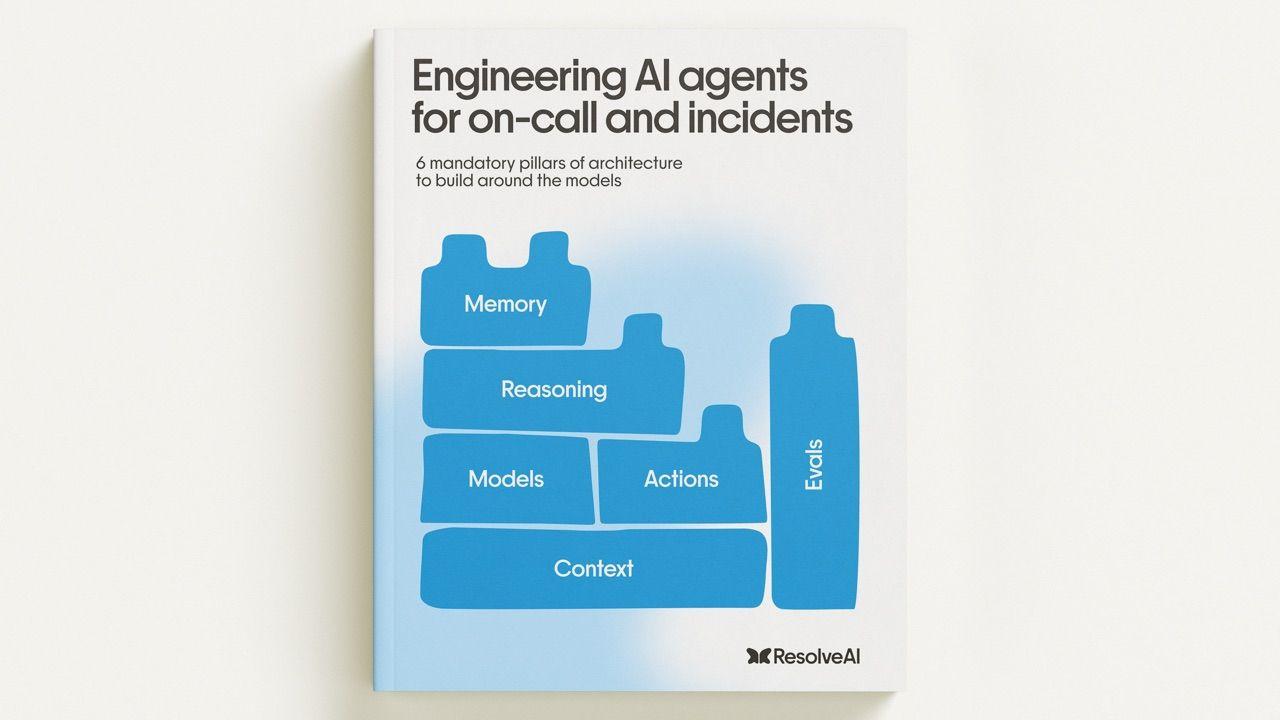
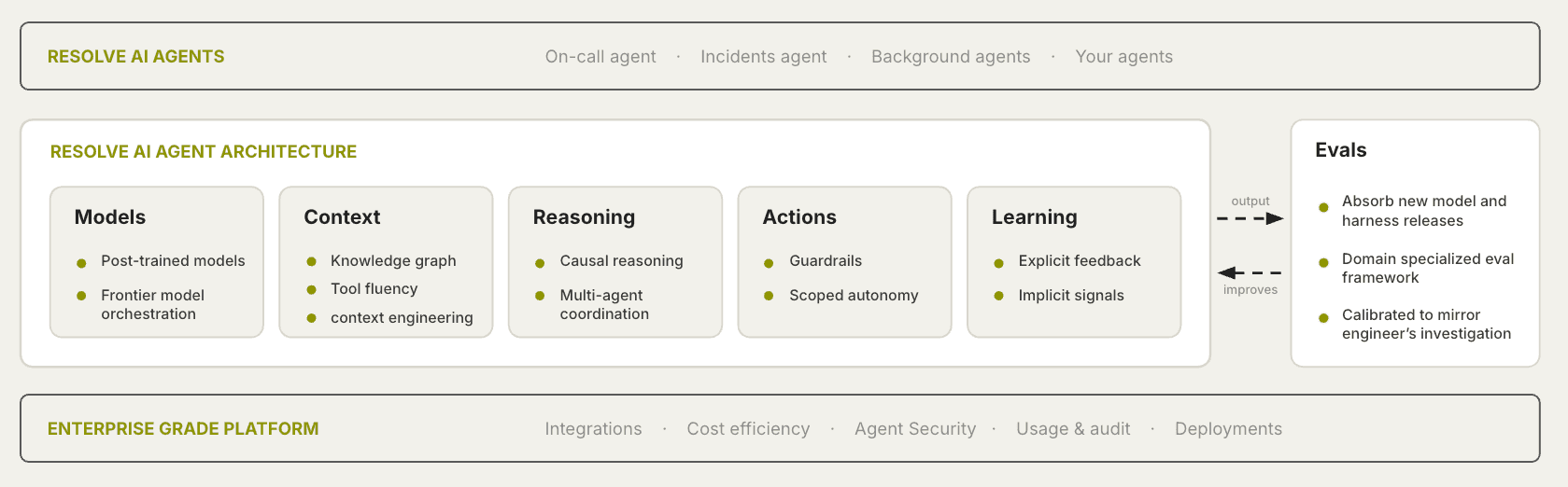
An agentic harness is the system built around a model to turn it into a working agent. For automated root cause analysis, the harness is six layers working together:
This is Resolve AI's published architecture: the agents on top and the enterprise platform, integrations, security, audit, and deployments underneath.
A checkout latency alert lands on an agent with no harness. The agent pulls recent logs from the alerting service, recognizes a familiar pattern, and writes a paragraph blaming elevated database load, with a recommendation to investigate the database. It sounds right.
But that is all that can be said. Without the reasoning and the context and the guardrails and the evals, an engineer can’t tell the difference between a coherent answer and a correct one. WIthout the harness, nothing gave the agent a way to look upstream, and nothing it did left a trail an engineer can verify.
Inside a production harness, the same alert goes differently, because the architecture works with the model:
The answer at the end is still a cause, but with the evidence attached, the alternatives ruled out, and every step logged, an engineer can verify it instead of taking it on trust.
An investigation flows through the layers in order, with feedback for learning.
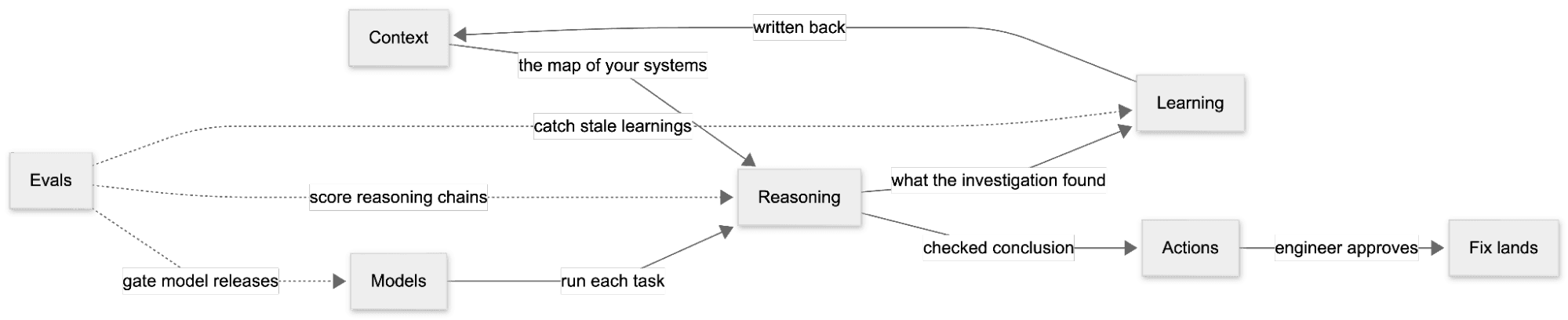
The forward path is the investigation. Context gives reasoning the graph of your systems and their current state, how they behave and how they fail. The models run each task inside that context graph, and the conclusion that survives verification goes to the actions layer, where the proposed fix waits for an engineer.
The loops are what make the system improve. Learning writes what each investigation found back into the context layer, so the context graph gets more accurate with use. Evals sit across everything as the measurement. They keep the best model on each job as new releases land, score whether reasoning chains hold, and catch learnings that no longer hold.
Remove one layer, and the others degrade. Reasoning without context is guessing across an unmapped system. Models without evals drift with every release. Learning without verification writes unchecked conclusions into the record. Each layer depends on the others, which is why the harness has to be built as one system.
The release cycle shows the same dependence. With a thin wrapper, the product is whatever the wrapped model does, so every release changes the product in ways nobody chose. With a real harness, a release is a candidate. It gets tested against investigation evals, adopted for the tasks where it wins, and rejected where it regresses.
Resolve AI benchmarked Claude Sonnet 4.6 on production investigations within days of its release. That's what the process looks like from the outside.
A DIY route can produces a real harness. A prompt plus LangChain plus connections to a few tools is good starting point for a harness, and will handle simple single-service failures well enough to impress.
What the minimal harness lacks is the six layers' content. The framework brings tool calling, control loops, memory primitives, and retries. But it will still be missing a model of your systems, production failure knowledge, investigation evals, guardrails tuned to production actions, or a learning loop. No prompt can add those. Instructions only change how the model uses what it already has.
So each layer becomes its own project:
Teams that start down this path discover they're building an internal product, which is the honest version of the build-versus-buy question.
Automated RCA is an investigation method run by software. A production harness automates the method itself, generating hypotheses, choosing the evidence that separates them, and eliminating alternatives until the cause is found. DIY efforts plateau exactly there, on the method.
Most vendors lead with the model. Ask about the harness instead, because that's where the products actually differ.
The six-pillar architecture this page describes is Resolve AI's published design, with domain-specialized agents on top and an enterprise platform, integrations, security, audit, and deployment options, underneath. The architecture keeps evolving on purpose, absorbing each model release and capability as it lands, so investigations stay at frontier quality without anything on your side being rebuilt.
The results hold up in production. DoorDash Ads reduced time to root cause by up to 87% with Resolve AI, and Salesforce reduced it by roughly 60%. Book a demo to see the whole harness working on your own stack.
The system built around a model to turn it into a working agent. For automated RCA it includes the context layer, tools and permissions, reasoning structure, guardrails, a learning loop, and the evals that measure investigation quality.
An agentic harness is not the same as an agent framework. Frameworks like LangChain provide generic plumbing, tool calling, loops, and memory primitives. A harness is the domain content built on top, the model of your systems, the production knowledge, the guardrails, and the evals. The framework is a starting point, and the harness is the product.
The harness matters more than the model for automated RCA. The same model produces very different investigations depending on what it knows, what it can do, and how its work is structured and checked. Model capability sets a ceiling, and the harness determines how close a product gets to it.
Six layers working together: models suited to the domain, context about your systems, causal reasoning with parallel hypotheses, guardrails on actions, a learning loop, and evals that gate every change.
You can, and the simple version comes together fast. The production version means building all six layers and keeping them current, which amounts to an internal product with a full-time team. Whether that's worth it depends on whether you want to build production AI infrastructure.
Stay current on how the best engineering teams are using AI in production. Customer spotlights, product updates, how-tos, and more delivered monthly.