Loading the page…

Machines on-call for humans
Machines on-call for humans

AI agents are heading to production, and multi-model orchestration decides their cost, reliability, and failure modes.
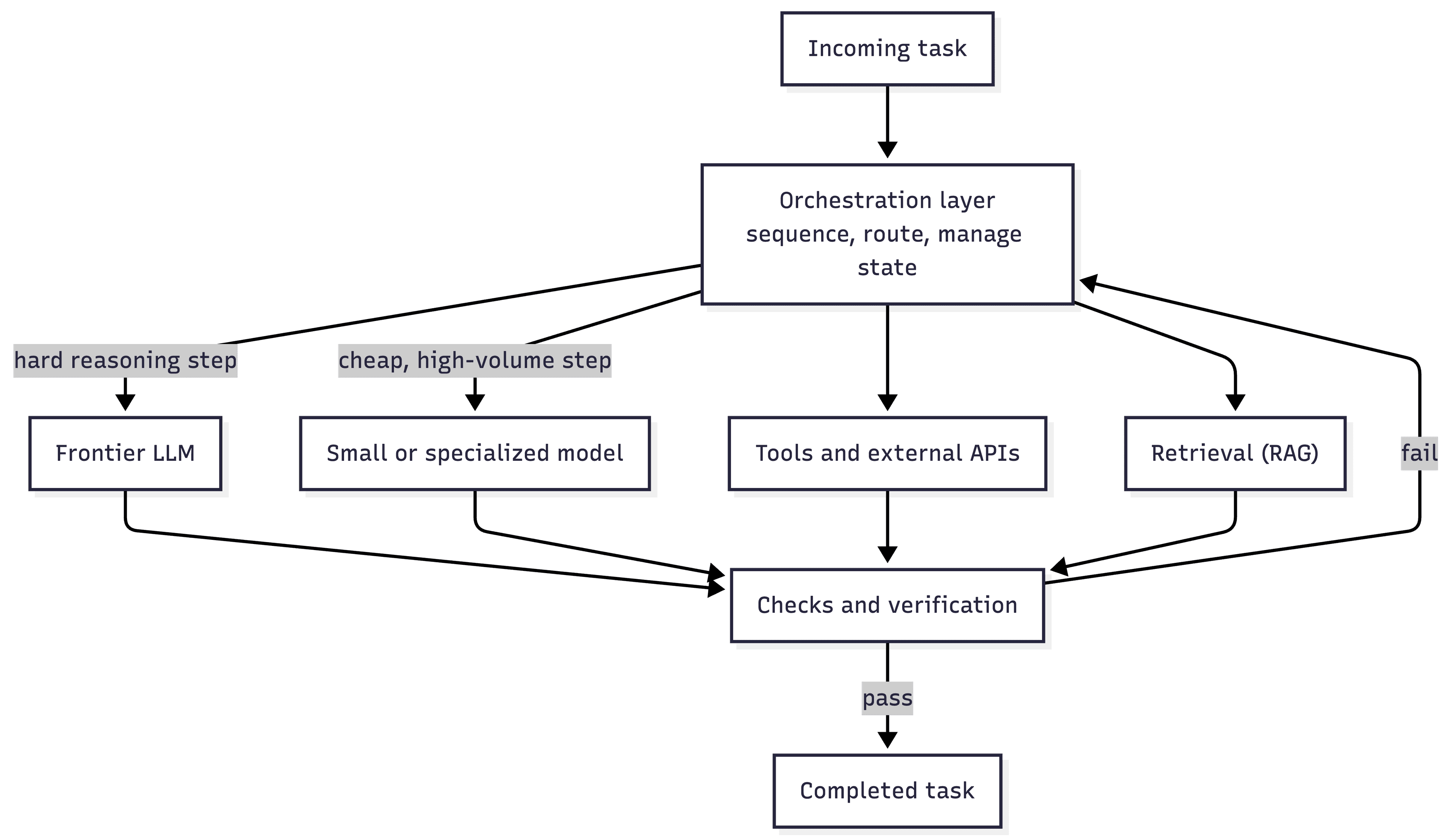
Multi-model orchestration is the coordination layer that routes work across several AI models, matching each step of a task to the model best suited for it and managing the state, tools, and checks in between.
The practice is spreading because AI agents are. Gartner predicts 40% of enterprise applications will ship with task-specific AI agents by the end of 2026, up from under 5% today. Each of those agents sits on an orchestration layer that someone has to design, deploy, and debug.
But Gartner also predicts over 40% of agentic AI projects will be canceled by the end of 2027, citing cost overruns, unclear business value, or weak risk controls. Each of those maps to an orchestration concern. Routing decides what the system costs, verification produces the evidence of value, and approval gates and scoped actions are the risk controls. Orchestration quality sits underneath all three.
Multi-model orchestration coordinates calls across multiple AI models, plus the tools, data, and APIs around them, so a multi-step task completes reliably. A single call to a large language model answers a question. A multi-model system chains calls together, checks intermediate outputs, retrieves context, and hands work between models to finish jobs no single call could handle.
It helps to separate three levels.
Here's a concrete pass through the layer: an alert fires and a classifier model tags it as a latency regression. The orchestrator pulls recent deploys and service topology into context, a reasoning model generates hypotheses, and cheaper models fan out in parallel to query logs and metrics for each one. A verification step checks the surviving hypothesis against the evidence, and a summary posts to the channel. That's seven steps, at least three models, and state carried across all of it.
Production raises the stakes at every level. Once a system built on LLMs and agentic AI makes its own decisions at runtime, how it's coordinated determines how it behaves, what it costs, and how it fails.
Whether the system runs one model or ten, the orchestration layer ends up owning the same cross-cutting concerns:
Costs scale with model calls, and which model takes each call is an orchestration decision. The Twitter/X term for getting that decision wrong by default is tokenmaxxing, which means pointing the largest model at every step with as much context as it will take. Quality doesn't scale monotonically with context, frontier pricing at production volume strains budgets, and every release changes which model fits each subtask best.
The multi-model alternative decomposes the workflow and routes each subtask to the cheapest model that clears the quality bar. Three patterns do most of that work:
The savings are real, and the routing logic becomes a production component that can itself fail. A provider-side formatting change can silently break the cheap model's output check, escalating every request to the expensive tier until the bill arrives. Cost per request and escalation rate deserve the same performance monitoring as any other production metric.
Orchestrated systems fail mostly through design and coordination problems rather than raw model capability. The best public evidence comes from multi-agent systems research at UC Berkeley. The MAST study analyzed more than 1,600 execution traces across seven multi-agent frameworks and cataloged 14 distinct failure modes in three categories: system design issues, misalignment between agents, and weak task verification.
Most production multi-model systems are also multi-agent systems, with different models behind different agents, so the findings carry over. The systems MAST measured failed on 41% to 86.7% of tasks, and in the traces, agents ignore each other's inputs, lose conversation history, repeat steps, or terminate early.
The study concludes that better base models alone won't fix the full taxonomy. The fixes are design work, and that work lives in the orchestration layer.
A few failure mechanics come up repeatedly in production:
Five workflow patterns cover most orchestration in production. Anthropic's Building Effective Agents divides agentic systems into workflows, where the developer defines the code paths, and agents, where the model directs its own process.
Two of the five are inherently multi-model. Routing classifies each input and sends it to a specialized prompt or model, and orchestrator-workers puts a central LLM in charge of breaking a task down and delegating pieces to worker models at runtime. The other three, prompt chaining, parallelization, and evaluator-optimizer, coordinate steps and can run on one model or several.
Beyond workflows sit autonomous agents: an LLM using tools in a loop, checking results from its environment at each step, and stopping when the task completes or an iteration cap hits. Anthropic's advice throughout is to build the simplest system that passes evaluation, because every added step is another place for errors to compound.
Orchestration vocabulary overlaps heavily, partly because the term grew up in two different corners of engineering.
The older sense comes from MLOps, where ML orchestration (or machine learning orchestration) means scheduling the stages of ML pipelines: data ingestion, preprocessing, model training, evaluation, and deployment. Tools like Apache Airflow, Kubeflow, Prefect, Dagster, and Metaflow define those stages as DAGs (directed acyclic graphs) and run them on infrastructure like Kubernetes, with MLflow often alongside for experiment tracking and model versioning.
The newer sense comes from generative AI, where general-purpose LLMs replaced the older natural language processing (NLP) pattern of training one model per task. Frameworks like LangChain and LlamaIndex popularized orchestration as the word for coordinating prompts, tool calls, retrieval-augmented generation (RAG), and memory.
The two senses are converging. Data orchestration tools like Prefect and Dagster now schedule LLM workloads next to the ML models they already managed, and platforms like Databricks run ML pipelines and generative AI side by side.
Within the generative sense, the neighboring terms differ mainly in emphasis, and vendors often pick labels for differentiation rather than precision:
| Term | What it emphasizes |
|---|---|
| Model orchestration | Connecting a single model to the right context, tools, and workflow steps |
| Multi-model orchestration | Routing work across several models, with shared state and coordination between them |
| AI orchestration | The umbrella: coordinating any mix of models, agents, tools, and data across a workflow |
| LLM orchestration | Coordinating language model calls specifically: prompts, retrieval, memory, output handling |
| AI agent orchestration | An LLM acts as the decision-maker, planning actions and calling tools instead of following fixed code |
| Multi-agent systems | Several specialized agents that communicate and share state, with orchestration managing the traffic between them |
| Workflow orchestration | Predefined, mostly deterministic steps (the sense data teams use for Airflow-style DAGs) |
All of them describe the same underlying problem, coordinating computation, viewed from different angles.
It takes the same practices that keep any production system healthy: end-to-end tracing, retries, alerting, and the ability to investigate when behavior drifts. An orchestrated AI system is a distributed system, after all: non-deterministic, spread across services and external APIs, and prone to failing in multi-step causal chains that are hard to reconstruct afterward.
That's also the discipline behind Resolve AI. Resolve is AI for production systems: purpose-built agents that investigate incidents across code, infrastructure, and telemetry, and multi-model orchestration is the first of the six pillars of the agentic harness it runs on.
Each investigation step routes to the best-fit frontier model across the Anthropic, OpenAI, and Google families, optimized automatically for incident reasoning, tool use, long context, and cost. The orchestration layer absorbs the changes every model release brings, rather than passing them on to your team.
Alongside the frontier models sit proprietary models post-trained for causal reasoning across production systems, plus custom verifier models that score open-ended investigations, the task verification the Berkeley taxonomy flags as a weak point. On DoorDash's ad platform, that architecture cut time to root cause by up to 87%, and Salesforce reported a roughly 60% drop in MTTR.
As more of your stack runs on orchestrated models, that investigation layer matters more, whether the thing that broke is a service, a data pipeline, or the AI sitting on top of them. See it in action.
Stay current on how the best engineering teams are using AI in production. Customer spotlights, product updates, how-tos, and more delivered monthly.