Resolve AI Labs
Building models, evaluation systems, and agent architectures required for AI to reason about and operate complex production environments.
Our Mission
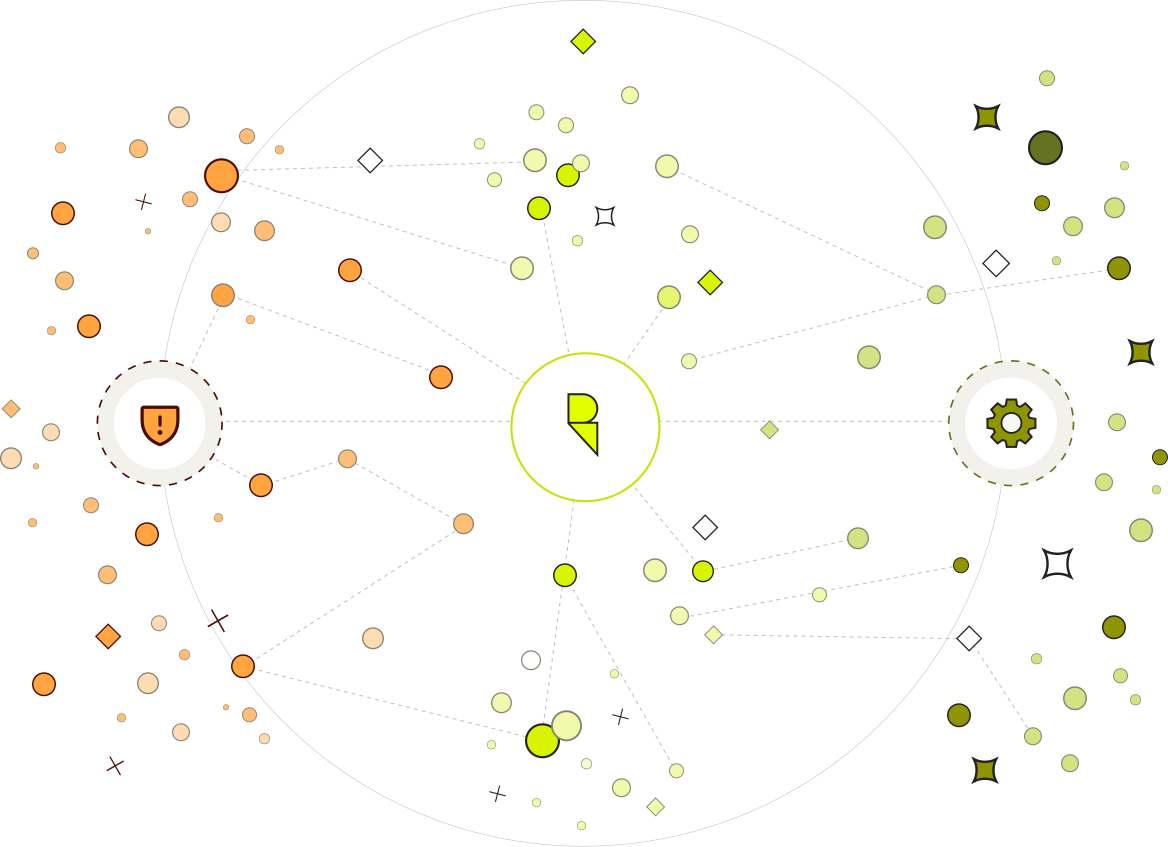
The next frontier is not writing software, but operating it. Our mission is to enable AI systems that safely and reliably operate the worlds production software, freeing engineers to innovate more.
Humans of the Labs
Built by researchers and engineers from leading AI labs, working alongside teams operating some of the worlds most complex production systems.
Thinkers
Researchers from Meta Superintelligence Labs, Google Deep Research and others, advancing domain-specific models, evaluation systems, and simulated environments for AI in production.
Builders
Engineers with deep observability and infrastructure domain expertise are building the foundation and systems required for reliable AI operation in complex production environments.
Collaborators
Partners from transformative teams operating complex and dynamic production systems, grounding the labs' work in real-world complexity.
Production systems require more than general purpose AI
Fragmented system signals
Production systems are dynamic, distributed, and stateful. Failures emerge across services, dependencies, and time, not in isolated tasks.
Massive search space
Resolving issues to optimization, spans thousands of services, petabytes of telemetry, and deep dependency chains.
Long-running, multi-agent orchestration
Agents must investigate over extended periods, share evidence, and cross-validate hypotheses - this is beyond any single-turn reasoning.
Our research focus
Domain-specific models
Training models that are best-in-class at production tasks
Evaluation systems
Systems for evaluating correctness, reasoning quality, and reliability in production workflows without clean ground truth.
Simulated environments
Execution frameworks for tool use, guided remediation, approvals, and safe action under operational constraints.
Agentic-systems and controls
Multi-agent systems that investigate, diagnose, and coordinate across distributed production environments.
Evolving the way humans and machines work
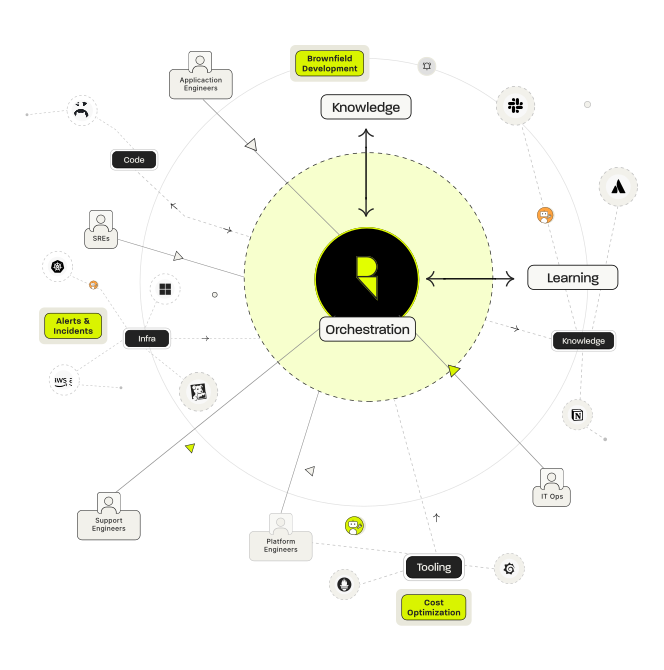
The shift is from AI-assisted to human-on-the-loop: humans define policy, guardrails, and exceptions while AI systems execute within those boundaries.
AI-Assisted
AI supports investigation. Engineers stay in the drivers seat while AI surfaces context, correlates signals, and suggests next steps.
HITL
AI proposes actions. It drafts remediation plans, suggests changes, and presents options for human-in-the-loop (HITL) review before execution.
HOTL
AI acts within guardrails. Autonomous operation for defined scenarios, with humans-on-the-loop (HOTL) setting policy and handling exceptions.